

Contributors

Subscribe to our newsletter
Turning comms expertise towards regen policy
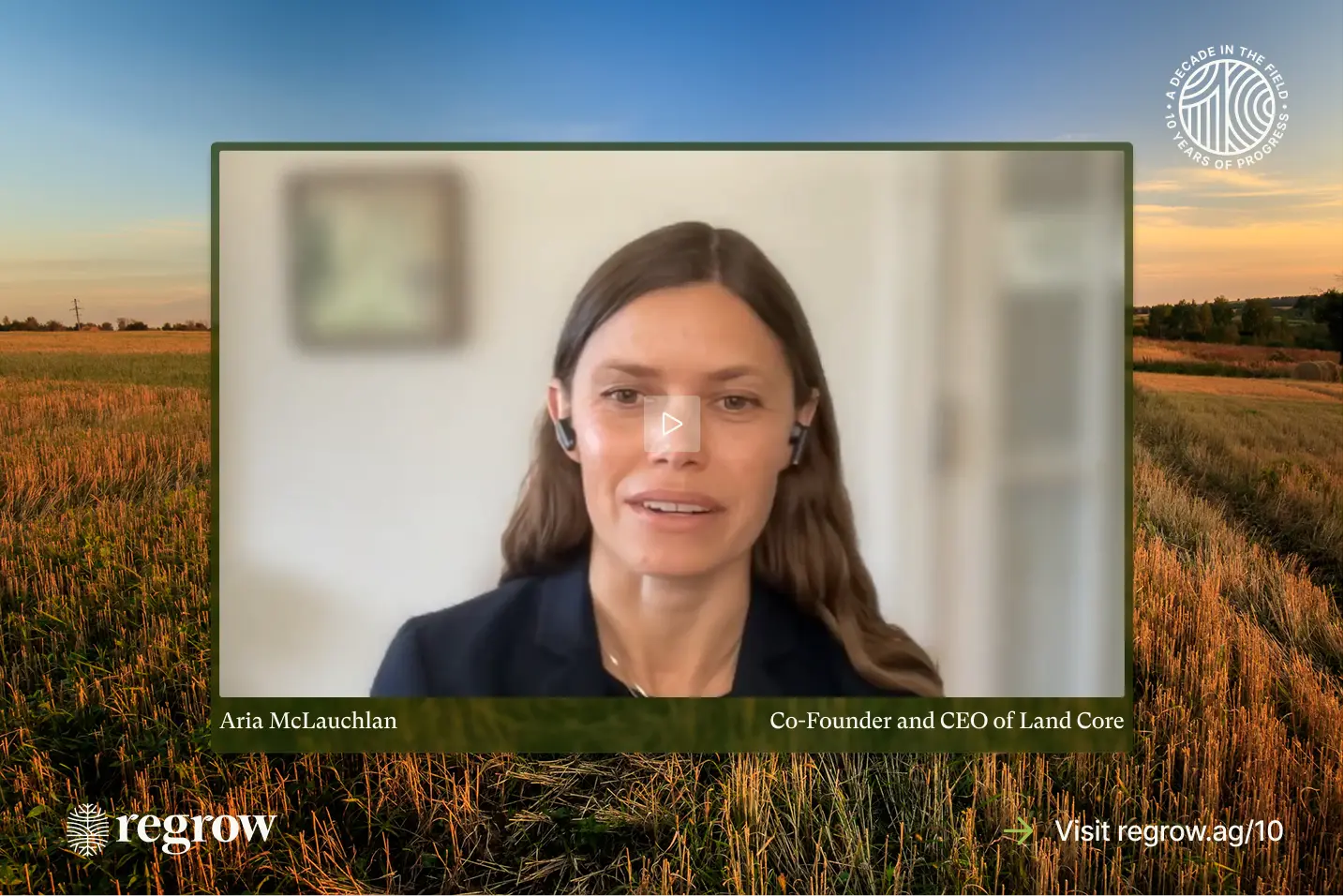
Aria’s path to soil health policy started in an unusual place: marketing. For over a decade, she built her career running campaigns for clients including Target, Coca-Cola’s Ekocycle, Rainforest Alliance, and the Wildlife Conservation Society across Los Angeles, New York, and Australia.
Aria then turned her skillset toward a California nonprofit focused on healthy soil. She went on to co-found Land Core, a 501(c)(3) nonprofit built to close what she saw as the biggest gap standing between regenerative agriculture and real scale: the lack of infrastructure and direct economic incentives for soil health.
In the years since, Aria has taken her communicator’s instinct for what moves people and institutions and applied it to one of agriculture’s most technical problems. As a result, she and the Land Core team have become extremely effective translators between soil science and Washington.
Land Core’s policy work helped secure $50 million in federal soil health investment through the 2018 Farm Bill and guided related soil health language through both the House and Senate in 2019; Aria herself was named a 2018 Exchange Fellow at the Stone Barns Center for Food and Agriculture and won the 2021 Emerging Leaders in Food & Agriculture award.
“Agricultural policy is just such a major lever of what happens in the space,” she says, “and getting the private sector to treat it that way, rather than as someone else’s job, is a really crucial aspect of this shared work.”
Aria’s skills in communication and experience in policy give her unique insight into the evolution of regenerative agriculture over the last 10 years, and what it will take to scale efforts in the future. Our conversation highlighted the importance of collaboration between policy and business to appropriately incentivize regenerative practices, and surprisingly, showed us that we all have a bit more common ground than we think.
Policy and business have collaborated to scale progress
Ask Aria what’s changed most in the decade she’s spent on soil health policy, and she’ll point directly at stakeholder attitudes across the ag value chain. Aria has seen broad recognition, among both policymakers and farmers, that federal policy is a lever worth pulling rather than a hurdle to work around. It determines the subsidies, safety nets, technical assistance, and operating capital that let farmers take on the risk of changing how they farm (a reminder that this impacts taxpayers too, as they cover over 60% of the federal safety net on which farmers rely).
Aria has also seen changes in who shows up to pull that lever. Businesses, Aria says, have moved from a posture of deregulation-only advocacy to proactively engaging in the policymaking and programs that support farmers directly.
“Businesses need to be involved in the sort of proactive policymaking and programs that support farmers and agriculture,” she says.
This is a shift she traces largely to corporate Scope 3 commitments and a broader interest in derisking their supply chain. Companies realized that they can’t underwrite practice change without help from other sectors. “Businesses… can’t fully provide the financing for the sort of transition and maintaining of more regenerative practices.” Government has to be a partner in this effort, and over the last 10 years the industry has recognized that collaboration is necessary for businesses to reach Scope 3 goals and resilience at scale.
This recognition runs in both directions. Federal programs that provide cost sharing for regenerative practices, though powerful, won’t help businesses fully realize their goals for resilience across their supply chains. These businesses are also beginning to step in to fund technical assistance and support new solutions related to crop insurance , rather than watching from the sidelines. Although there’s still plenty of ground still to cover, industry continues to mature in its understanding of the ways it can best partner with farmers and ranchers to achieve shared goals around profitability and resilience. Clear policy signals, in turn, tell businesses when it’s safe to lean in and match public investment with their own. Climate and supply chain risk, from extreme weather to procurement disruption, has only sharpened the focus.
Outcomes drive change
If there’s one conviction that defines Land Core’s approach, it’s outcomes over prescription. “Not just ‘did we do it,’ but ‘did it work?’ is a really important question to ask ourselves,” Aria says.
This distinction may sound obvious until you look at how most conservation programs are actually built. Programs pay producers for adopting a specific practice, like no-till farming, rather than for the results that practice is supposed to produce. The problem, in her view, is that no single practice suits every crop, region, or soil type.
“The emphasis on context in regenerative agriculture is incredibly important,” she says, and “a focus on outcomes allows a producer or a business to take into account where is this happening.”
At its core, emphasizing outcomes over practices allows farmers to adopt the practices that will best fit their ecosystems and products. It allows farmers to maintain decision-making power and stewardship over their land, while allowing new profit streams to support the transition to regenerative practices.
That said, Aria recognizes that incentivizing only outcomes isn’t entirely realistic. She’s candid that practice-based lists can be the pragmatic choice in policy design when an agency doesn’t yet have the capacity to build an outcome-verification system from scratch. This nuance keeps her outcomes-first philosophy grounded in how policy is actually written, not just how it should work in theory.
The throughline connecting outcomes to Land Core’s policy agenda is risk. Aria wants outcome-based incentives built on actuarially sound assessments of how much a given practice reduces risk on the landscape in the same way an insurer prices any other risk.
“We should be looking at… where and to what extent these practices reduce the risk on the landscape,” she says. “You can start to price and incentivize practices and outcomes that really are grounded in the impact that they can have.” It’s a subtle but important reframing: soil health stops being a values-driven aspiration and starts being a number an actuary can underwrite.
Let’s apply good practice discounts to soil health
Pull Land Core’s thinking about outcomes and risk forward ten years, and it lands on a single, vivid idea: a “good soil discount” on crop insurance. “We envision a world in which there is a good soil discount that is as ubiquitous as a good driver discount on auto insurance,” she says.
Here, Aria and her team show that risk reduction discounts aren’t hypothetical, and they have precedent.
“There’s an existing market for this, there’s precedent in other industries or verticals, especially in insurance,” she notes. pplying that logic to farmland is more complex, but she considers it worth the complexity, pointing to a growing convergence of philanthropists, researchers, insurers, and lenders around the same risk-reducing case for regenerative practices. As she puts it bluntly:
“Show me a farmer who doesn’t want better soil health or who wouldn’t be interested in a discount on their crop insurance.”
Staying power across the political spectrum
What makes Aria genuinely optimistic is the breadth of people willing to sign onto these ideas. Soil health, in her experience, is one of the rare policy issues with real staying power across the political spectrum, resonating with MAHA advocates, climate activists, and skeptical business people alike. Land Core’s own federal soil health bill tracker counts more than 160 bipartisan bills introduced in Congress with a soil health impact, and progress has continued across administrations regardless of which party holds power. “The staying power and the true sort of common ground appeal of soil health and what we now call regenerative agriculture” is, in Aria’s view, the thing most worth underscoring. “Even in a time where folks can feel like national politics are stalled or complicated,” she says, “the focus on soil health really does have a lot of possibility behind it.”
It’s a rare kind of optimism, rooted in watching the common ground get a little wider every year.
Learn more about the past and future of regenerative agriculture in our series, A Decade in the Field →