

Contributors
Subscribe to our newsletter
Europe has made significant progress toward building a trusted market for carbon removals and carbon farming through the Carbon Removals and Carbon Farming regulation (CRCF). Much of the recent discussion has focused on creating demand for certified carbon farming outcomes, but demand alone will not determine whether CRCF succeeds.
The framework's long-term success will depend on a series of technical decisions that are now being developed through delegated acts and certification methodologies. These decisions will determine how environmental outcomes are measured, verified, and certified in practice.
In our view, this is where CRCF will have the highest impact on carbon markets.
The tradeoff between credibility and cost
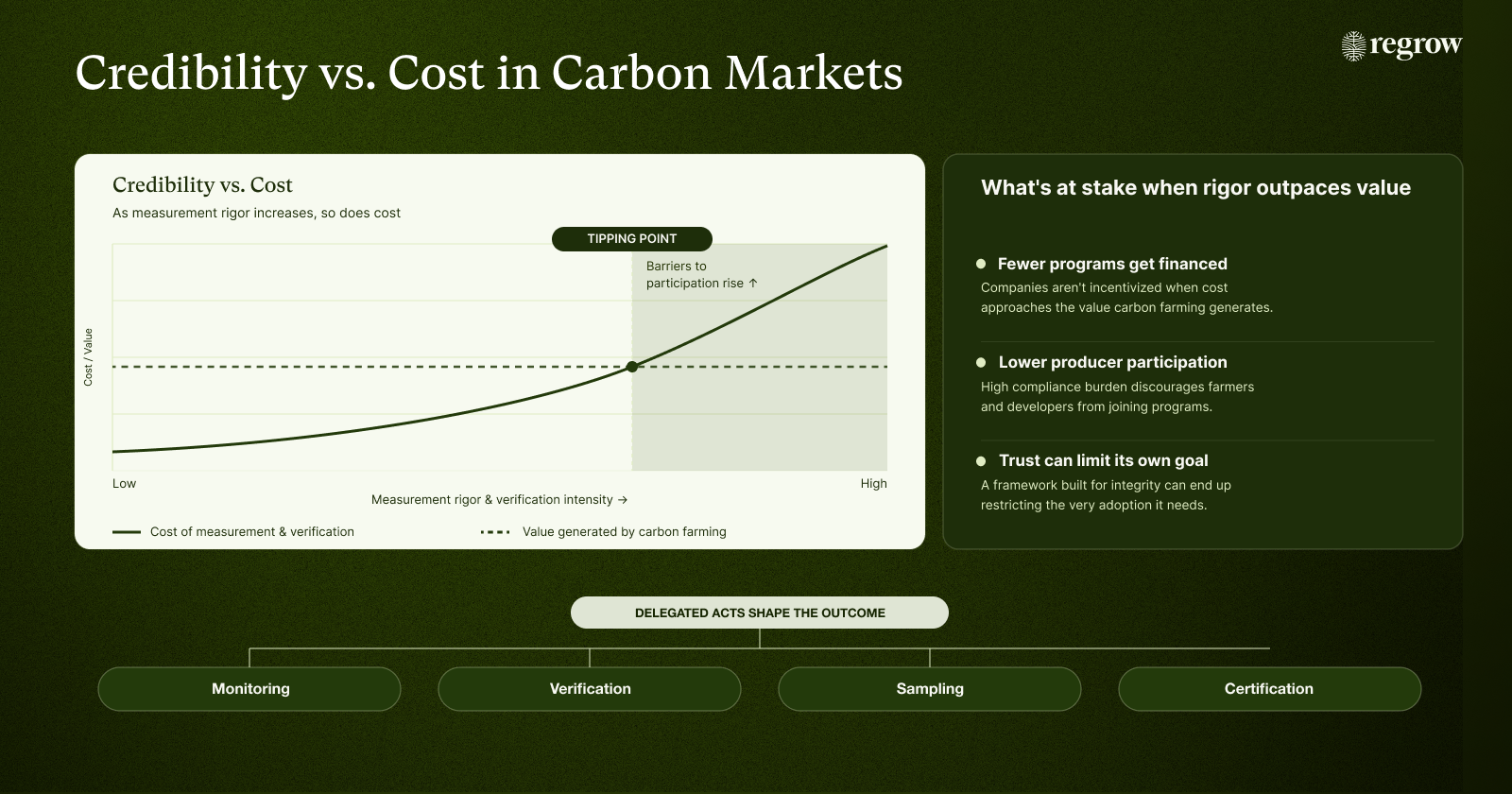
Every certification system faces a fundamental challenge: increasing measurement rigor also increases cost.
More intensive field measurements, additional verification requirements, and greater administrative complexity can improve confidence in reported outcomes, but they introduce significant barriers to participation.
If the cost of measurement approaches or exceeds the value generated by carbon farming, companies will not be incentivized to invest and fewer programs will be financed. Consequently, a framework designed to build trust can limit adoption.
The delegated acts now under development will shape requirements for monitoring, verification, sampling, and certification. This design will determine whether the framework is economically viable across Europe's diverse agricultural landscape.
This is not a choice between credibility and scalability
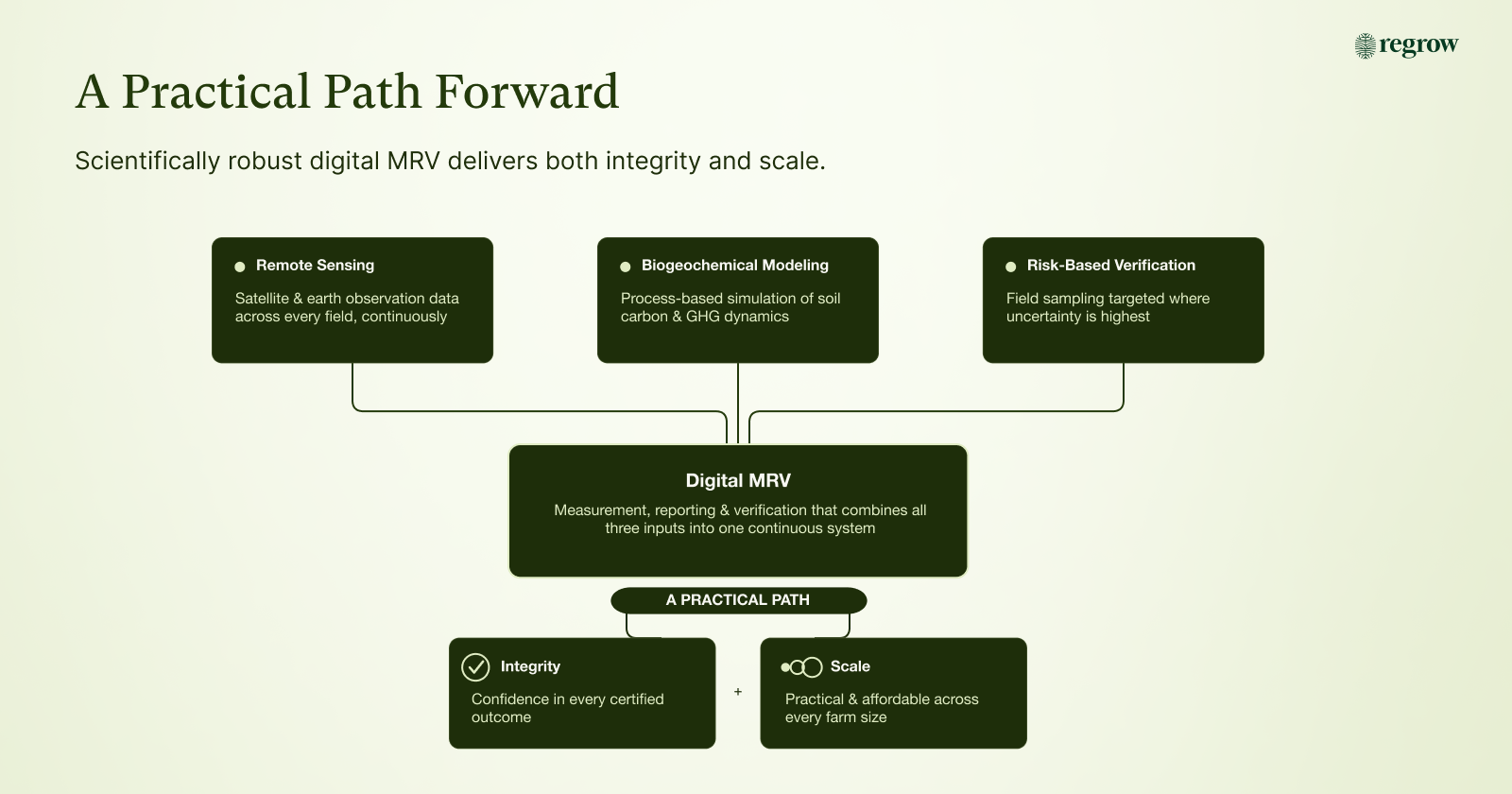
Over the past decade advances in remote sensing, Earth observation, farm management data, and biogeochemical modeling have improved our ability to measure environmental outcomes across agricultural systems.
These technologies make scientific measurement and independent validation more efficient. Rather than requiring intensive field sampling across every hectare, digital measurement approaches can identify where uncertainty is highest and where additional verification will have the greatest impact.
The same principle applies to risk-based verification. Not every farm, field, or project presents the same level of uncertainty. Verification resources can be focused where they provide the greatest assurance while maintaining confidence across the broader system.
This approach preserves scientific integrity while reducing unnecessary costs, making high-quality certification more practical for both project developers and farmers.
The delegated acts are an opportunity to build for scale
In Europe’s diverse agricultural systems, certification methodologies must work across different climates, soils, cropping systems, and farm sizes while remaining economically accessible.
If certification methodologies rely heavily on intensive manual sampling and verification across every project, participation costs will rise and could lower participation.
However, scientifically validated digital MRV, combined with risk-based verification and targeted field measurements, offers a path toward maintaining rigorous standards while making certification practical at continental scale.
As delegated acts continue to be developed, there is an opportunity to build methodologies that achieve both objectives.
Building markets that last
CRCF has the potential to become one of the world's most important frameworks for agricultural climate action. Achieving that potential will require certification methodologies that deliver market confidence without creating unnecessary barriers to participation.
We believe scientifically robust digital MRV, supported by remote sensing, biogeochemical modeling, and risk-based verification, provides a practical path toward achieving both integrity and scale.
Balancing integrity and scale will ensure that more investment reaches farmers while building the trusted environmental measurement infrastructure that agriculture will increasingly depend on in the years ahead.