

Contributors

Subscribe to our newsletter
As Europe implements the Carbon Removals and Carbon Farming Regulation (CRCF), one question continues to dominate the conversation:
What will create long-term demand for carbon farming?
Will voluntary carbon markets provide enough investment? Will compliance markets eventually become the primary driver? Will corporate supply chains, sustainability-linked finance, or public incentives play the biggest role?
These discussions often assume there will be one "winning" source of demand. In reality, different sources of demand will play different roles over time. Voluntary markets can help prove new approaches and mobilize early investment, but long-term market transformation will ultimately depend on mandatory demand becoming part of the new normal. CRCF represents an important step in creating that transition.
Agriculture already creates value in multiple ways
Farmers rarely adopt new practices for a single reason. A practice might improve yields, reduce fertilizer costs, increase resilience to drought, qualify for public incentives, support a corporate sourcing program, and generate measurable environmental outcomes concurrently.
Agricultural systems already produce multiple forms of value. Carbon markets should reflect that reality rather than forcing every outcome into a single commercial pathway.
CRCF presents an opportunity to build an accounting framework that allows different environmental outcomes to be recognized across multiple programs while maintaining transparency, attribution, and protection against double counting.
Different investors are solving different problems
Not every organization investing in agriculture is trying to achieve the same outcome. A food company may be focused on supply chain resilience, whereas a financial institution may prioritize reducing climate-related portfolio risk. Public agencies may invest to improve water quality, biodiversity, or rural economic development, and future compliance markets may require verified emissions reductions or carbon removals that satisfy regulatory obligations.
These objectives often rely on the same underlying environmental data. Rather than creating separate measurement systems for each market, CRCF has an opportunity to establish a common accounting infrastructure that allows one trusted foundation to support many different applications.
Diversification creates more durable markets
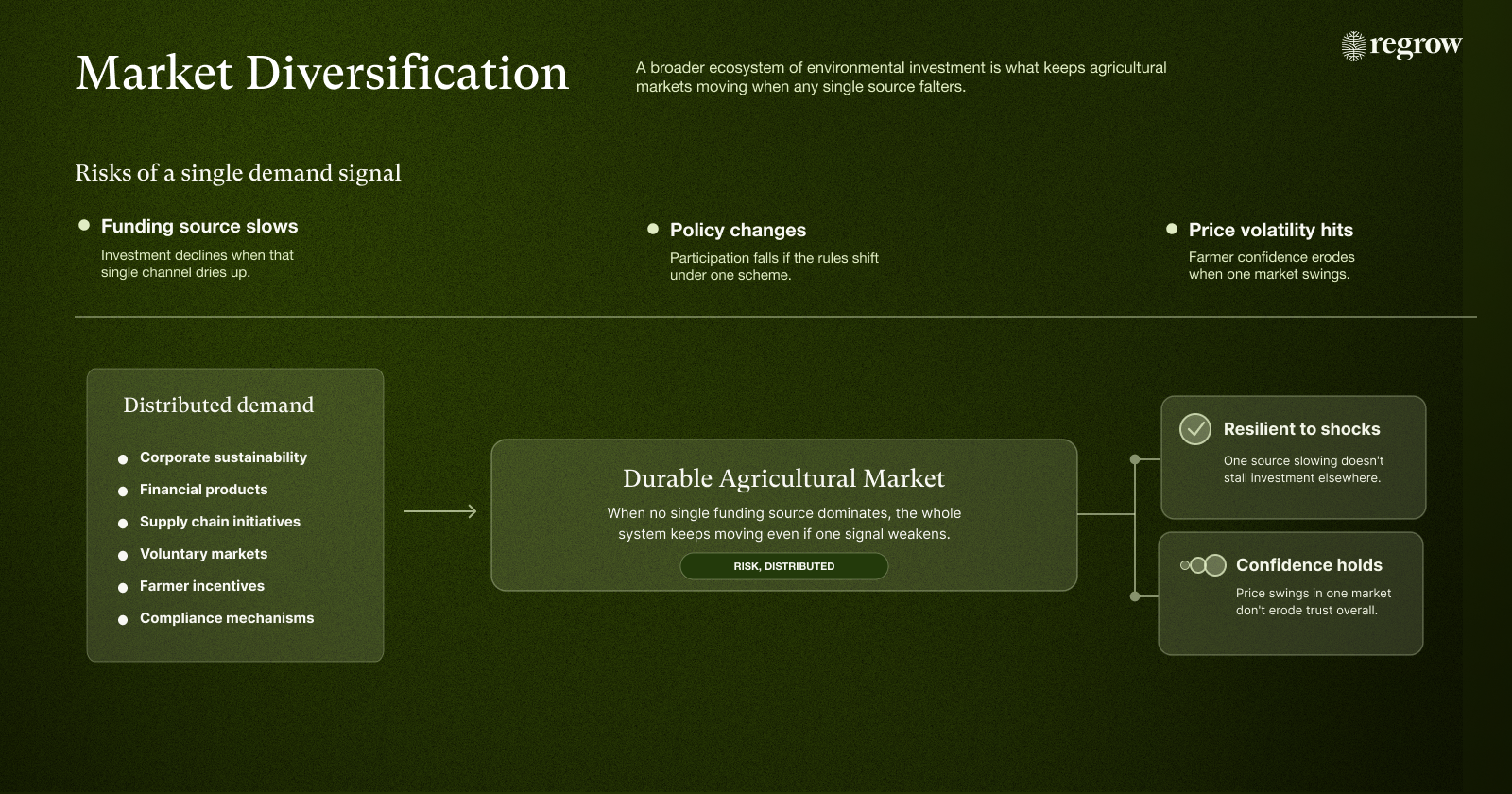
Markets built around a single demand signal are inherently more vulnerable. If one funding source slows, investment declines. If one policy changes, participation falls. If one market experiences price volatility, farmer confidence can erode.
More resilient markets distribute risk. Rather than relying exclusively on voluntary carbon markets or waiting for compliance markets to mature, CRCF can provide a framework that supports a broader ecosystem of environmental investment.
Corporate value chain investments should remain at the center of this ecosystem, complemented by public incentives, sustainability-linked finance, voluntary markets, and future compliance mechanisms. Together, these funding sources can reward agricultural outcomes while supporting long-term supply chain resilience.
Diversification helps create a more durable market.That said, diversification should not be interpreted as equal dependence on every funding source. Long-term market stability is most likely to come from a combination of strong value chain investment and growing mandatory demand. Compliance mechanisms provide the certainty needed to scale investment, while voluntary markets continue to play an important role in testing new approaches, demonstrating value, and accelerating adoption before regulation catches up.
Shared measurement makes diversification possible
Whether environmental outcomes are used for corporate reporting, sustainability programs, public incentives, financial products, or regulated markets, participants need confidence that outcomes have been measured consistently and can be transparently attributed to their intended use.
Without common accounting rules, every program risks creating its own definitions, methodologies, and verification requirements. That fragmentation increases costs, reduces comparability, and limits participation.
CRCF has the opportunity to establish shared measurement infrastructure that allows environmental outcomes to support multiple decision-making processes while maintaining integrity through clear governance, traceability, and protection against double counting.
Building systems that can evolve
The balance between voluntary markets, compliance mechanisms, corporate investment, sustainability-linked finance, and public policy will almost certainly change over time.
The frameworks flexible enough to accommodate diversified funding sources will be most enduring.
When solidifying CRCF, we should be asking if the framework can provide the trusted accounting foundation that allows many different markets to operate together.
The future of carbon markets will depend on creating a trusted, transparent system that enables many sources of investment to work together. While voluntary markets will continue to play an important role in innovation and early adoption, long-term market transformation will require mandatory demand that embeds carbon farming into mainstream agricultural markets. By creating trusted accounting infrastructure today, CRCF can help reduce future transaction costs, increase investor confidence, and accelerate that transition.