
Contributors

Subscribe to our newsletter
Rewind to 2016. Satellites had only just started delivering imagery frequent and sharp enough to watch crops in individual fields. Cloud computing was making it possible to run heavy models without a server room. Generative AI was barely a blip on the radar, and teams crunched numbers on graphic processing units in their own computers.
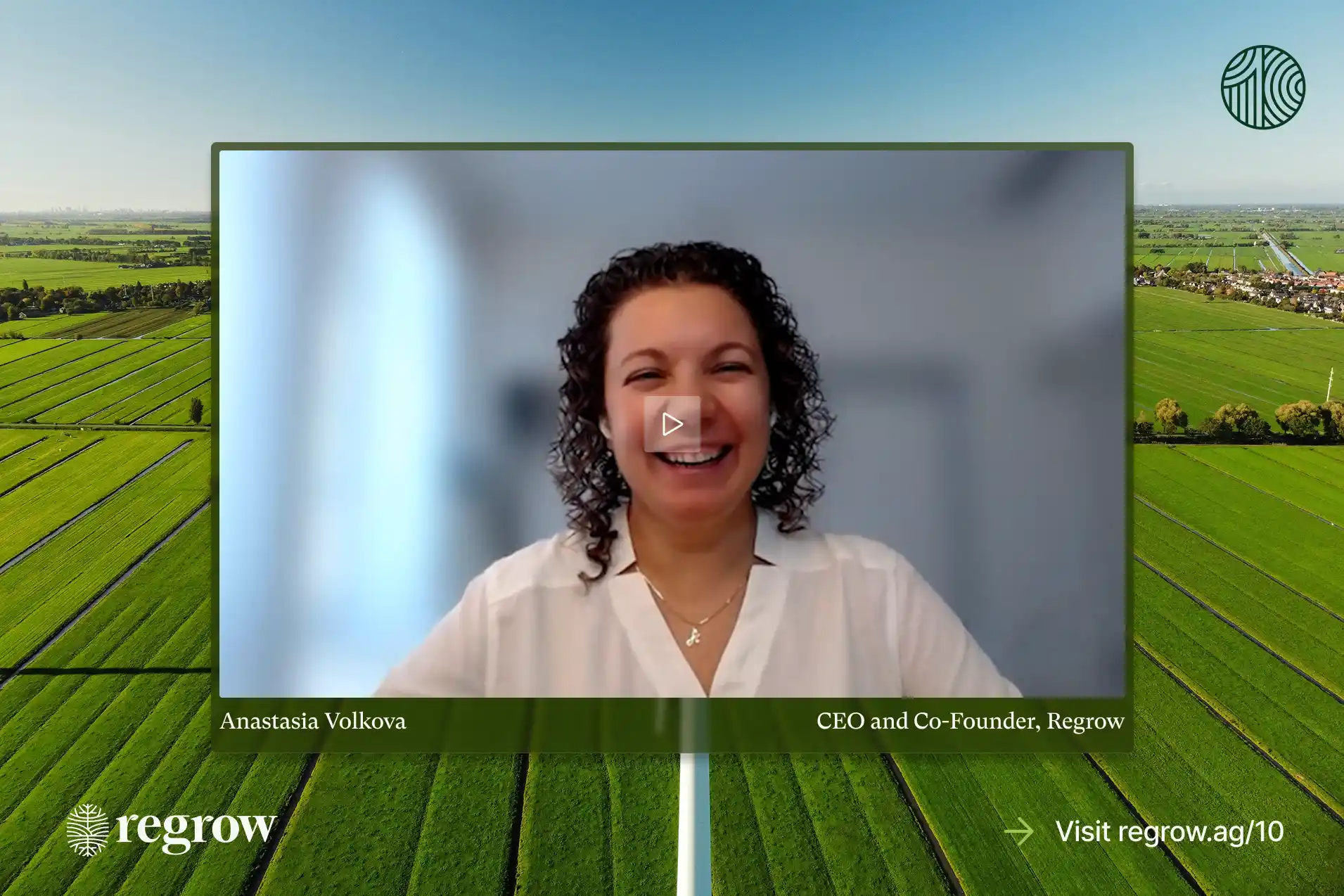
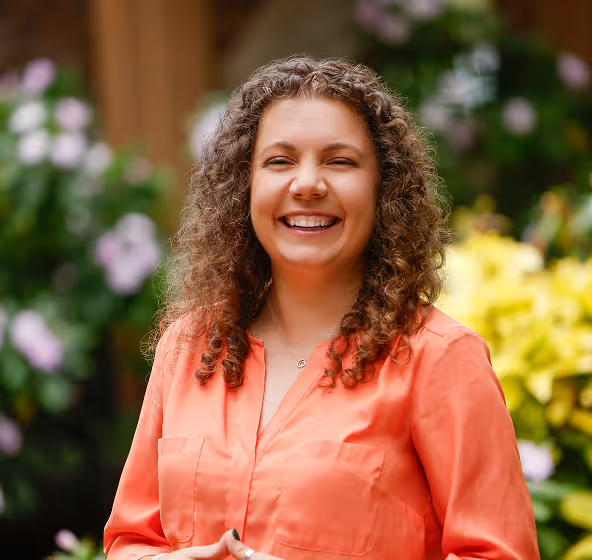
Anastasia Volkova, a Ukrainian-born engineer in the middle of a PhD on visual navigation at the University of Sydney, saw what those new tools could do for the people making decisions on the farm. So she started a company.
That company, FluroSat, later merged with Dagan to become Regrow. Ten years into the journey, Regrow now runs the largest independent MRV software platform in the market, with monitoring and measurement covering more than half the world's arable land. Along the way, Anastasia has been named one of MIT's 35 Under 35, one of the BBC's 100 Women and one of TIME's 100 Next leaders.
We asked her to tell the story of the last ten years from the inside. She came with a fresh perspective on Regrow’s history, a confession or two, and a dose of inspiration for the decade to come.
Starting with who's asking
Regrow-predecessor FluroSat had the same raw ingredients as its then-few competitors: fresh satellite data and an industry hungry for it. Anastasia thinks in retrospect that some of them were overly focused on the technology itself.
What gave FluroSat a leg up was the team’s ability to ask the right questions. The team weren't all agriculture insiders and didn't know the industry's unwritten rules, so they built communities and asked agronomists and sourcing companies directly: what data would help you make better decisions? Farmers and agronomists wanted decision support they could take into the field. Companies further downstream wanted to understand how their ingredients were grown and where the risks sat.
The question Anastasia kept coming back to, and one that still guides her today, is:
"How do you put the right information in the right hands, so that money, resources and investment move the system toward resilience and away from risk?"
Building a category from scratch
Through Regrow, Anastasia and Co-Founder Bill Salas built a digital monitoring, reporting and verification platform for regenerative ag programs. Early MRV wasn’t as smooth as it is today, though; it was more like a pile of isolated pieces. Monitoring and measurement were handled by different teams and entities, and information had to be stitched together to get a clear picture of a program’s performance. Anastasia came at the problem from an enterprise software angle, and she saw a whole workflow waiting to be connected: how a farmer gets enrolled and supported, what evidence gets collected, which quantification and verification methods apply, and how it all works with an auditor.
In building this enterprise software MRV, Regrow and its first partners walked into what Anastasia calls an "open space on the map" and started building. She gives much of the credit to the early Regrowers who designed for scalability and configurability from day one. That meant building for scenarios nobody could see coming yet, which is no small feat. The team had to choose what came first, so they started with the best model they could find, DNDC, and scaled to others later.
The team’s focus on scalability and configurability paid off because the ground never stopped moving. Regulatory frameworks updated roughly twice a year for five years straight, and every change had to hold up with scientists, policy experts, buyers and auditors. By the time the US administration started talking about MRV and climate-smart grants, Regrow’s products were already mature enough to meet the wave. Anastasia calls it the strongest product-market fit she has ever felt.
Three turns of the spiral
When considering Regrow’s business evolution, Anastasia describes the last decade as an upward spiral. Every three years or so, the market shifted and the company turned with it.
Turn one: the agronomist focus
At FluroSat, the team focused on optimizing agronomists’ time. Agronomists couldn't watch every acre their customers trusted them with, so the team built remote sensing, monitoring alerts and nitrogen management tools, right down to variable-rate files that went straight into tractors in the field. The core question was simple: is this farm in balance? What goes in, what comes out, and is it sustainable economically, socially and environmentally?
Turn two: the food company sustainability
Then the same agronomic questions became relevant for agriculture and sustainability professionals inside food companies. How can healthier soil help me reduce my carbon footprint? Can we incentivize supply chain partners for climate progress? The monitoring and modeling processes were the same, but now the goal had shifted to broader, supply-shed level impact across food companies’ primary ingredients and sourcing regions.
Turn three: supply chain risk and resilience
Today, most questions come from country managers and procurement teams looking across whole regions. Where should I invest to reduce climate and supply chain risk? Which regions are most susceptible to weather volatility, and how can I mitigate the impact?
Through every turn, one thing stayed the same.
"It all comes down to what happens in the field," Anastasia said.
The people funding the work and the reach of the models have scaled up enormously, but Regrow’s efforts still tie back to individual fields and farmers.
And the spiral keeps turning. Years ago, the team imagined cotton bales carrying traceable environmental benefits through the supply chain. That didn't exist then, but it does now, and Regrow’s ability to ask the right questions helped us predict this turn.
The tech under the hood
Anastasia is quick to say that the human side of this work, what it takes for people to change, matters far more than the technology. Still, the technology comes with some good stories about the evolution of the company and the industry.
In the early days, agronomists needed satellite results the same day, before heading out to the field. So the team built its own containerized processing pipeline from scratch, including a system that indexed the whole globe tile by tile. It had to run within hours, without interruption. That kind of capability is now public in Google Earth Engine, and Regrow was among the first to build on it once it arrived.
Then the team moved DNDC, APSIM, APEX and many other complex biogeochemical models and calculators into the cloud. These models traditionally ran as an executable file on a Windows PC. Regrow now runs them across more than half the world's arable land, cost-effectively, for current conditions and for future scenarios. That’s trillions of data points contributing to our understanding of agricultural land and soil health.
For years, the team has been investing in remote sensing AI, including pioneering the use of "transformers"—the industry's earliest Generative AI models applied to satellite imagery. These models enable faster, country-by-country mapping of crop types, planting and harvest schedules, and overall crop health. Powered by all this rich data within Regrow's Agriculture Resilience Platform and paired with recent advancements in AI, Anastasia envisions opportunities to reveal patterns that would be impossible to uncover manually. She is clear, however, that human reasoning remains essential; tools are ultimately only as effective as the questions we ask. For Anastasia and Regrow, the priority continues to be identifying and answering the right questions.
Climate solution or risk strategy?
Will this next turn of the spiral treat agriculture as a climate solution or a way to manage risk? Anastasia says it depends on an organization's history, culture and leadership.
Recent events have made the risk case hard to ignore. If your supply chain ran through Ukraine before Russia invaded, you felt the supply shock directly. If you sourced from Europe during a recent drought year, you may have had to import ingredients from another country or even another continent. Not to mention the forecasted impacts on tropical ecosystems of this year's mega El Niño. Experiences like these are helping make the case that regenerative agriculture is a strategic way to reduce risk, and one worth investing in, because soil health takes years to deplete and years to build back up.
"Businesses are very good at dealing with risk," she said. And for anyone who cares about handing the earth to future generations, the climate case matters just as much.
Either way, she thinks the core question has an obvious answer: "Is soil health vital for humanity surviving? Hopefully the answer is a resounding yes."
2036: little forests everywhere
When asked to picture the next ten years, Anastasia’s hypothetical crystal ball showed humans, not robots. Machines roaming the fields and AI in the tractor cab are easy enough to foresee, she said. What she hopes AI brings instead is "an incredibly urgent call to be human."
Her wish list for regenerative programs in 2036 is specific.
- They're a normal mode of procurement.
- They're heavily supported by government incentives that are fully aligned.
- They embrace the complexity of the natural world.
Programs should be "less of a top-down spread of the same," she said, and "more of growth of little forests everywhere with their own little ecosystems." That is, place-specific solutions, each growing on their own terms and solving the most important problems for that region.
She also hopes we all might get a little closer to food production, whether we live in rural communities or urban settings. There’s always more we can do to integrate ourselves with nature and gain a deeper understanding of our natural systems.
Stories and data, equally developed
When we asked her to reflect on program and practice adoption, Anastasia had a confession to share: for a long time, she believed data was the answer to accelerating change. Show people the evidence and they'll change. "Oh my God, how naive I was," she said laughing.
"People need stories to understand the data. People need to understand why it matters. People make changes because they are moved."
What moves people is hope, love and prosperity: a depleted farm returning to abundance, a family coming back together on the land. Her hope for the next decade is that rigorous data and human stories are intertwined and equally developed.
Beyond carbon
"There was so much talk about carbon [back then], but it's not about carbon," she said. Plenty of benefits go uncounted because the accounting system wasn't built for them. Take, for example, water: Regrow could model water outcomes long before the market showed real interest. Today we call it a co-benefit, but that makes it sound secondary. Water is, in fact, a primary benefit of regenerative practice adoption and should be treated as such.
Biodiversity is another open frontier. Anastasia is looking for ways to value whole ecosystems, and to bring in what Indigenous communities know about the land. She's candid that it isn't solved yet, and it remains an area crying out for innovative approaches and new ways of thinking.
Part of nature, not above it
We asked what advice she'd give herself as a new founder. Her answer was short and poignant: trust the future you envision. People who start companies see something others can't yet imagine, so plenty of people along the way won't see it either. One of Regrow's largest early customers told her outright that they couldn't tell her how to build the future, only what they needed. It would be up to her to envision and create the solutions to their problems. "Trust your intuition," she said. "You know what's right. Do it."
What makes her optimistic is the urgent call to climate action, and who's answering it. Younger and younger people are speaking up and taking legal, physical and commercial action toward a better balance with the natural world. "As humans, we are a part of nature. We're not above it," she said.
Her message to that next generation of leaders is direct: "If you think we, me, Regrow can help you, please do reach out. You are our future."
Here's to the next ten years.
Learn more about the past and future of regenerative agriculture in our series, A Decade in the Field →