Contributors

Subscribe to our newsletter
Rice has moved from promise to practice.
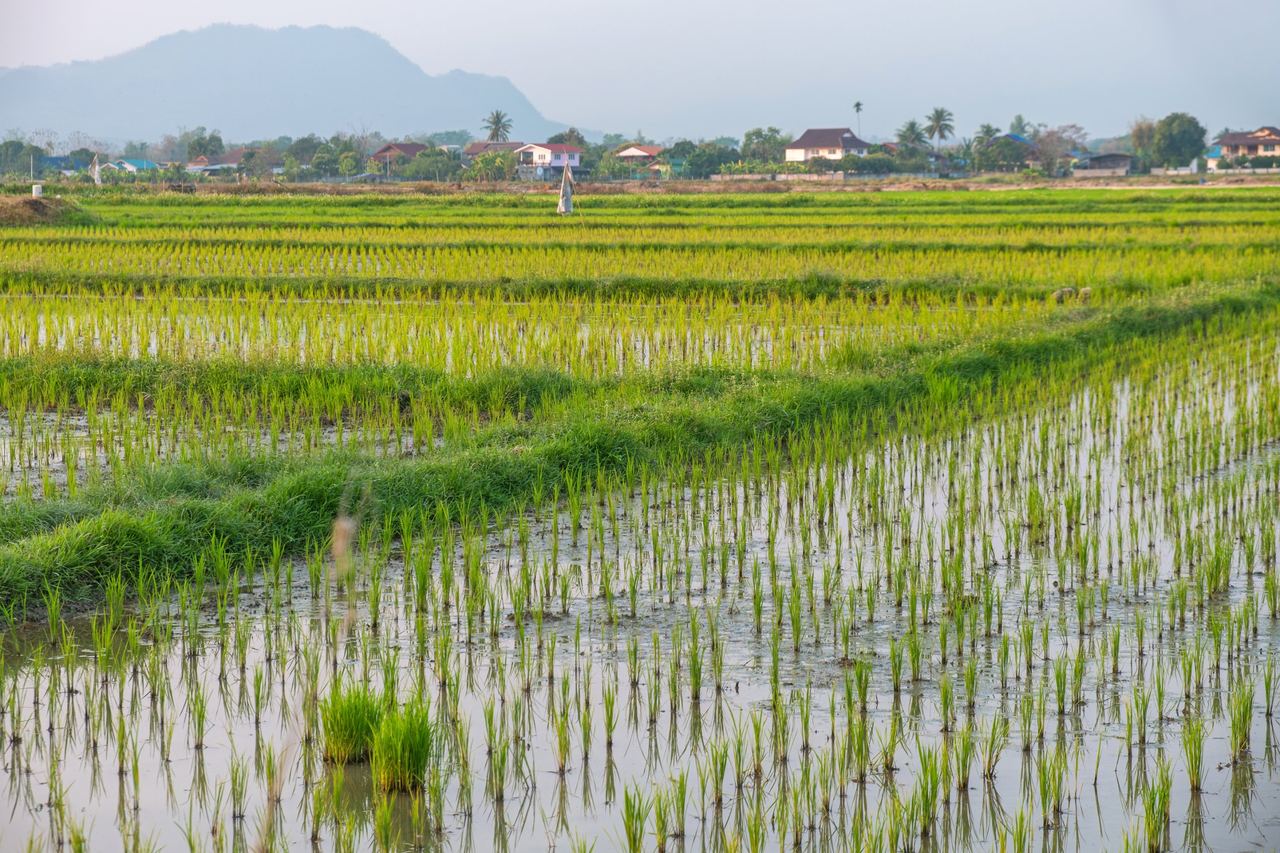
In 2023, we wrote about what it would take to transform rice production. Rice feeds approximately half of the world's population, yet rice farming accounts for a significant share of global methane emissions and consumes around 40% of global irrigation water. We argued that one of the biggest barriers to change was the lack of measurement, reporting, and verification (MRV) systems that could measure climate impacts at scale for a crop grown mostly by smallholder farmers.
Three years later, that barrier is coming down. Digital MRV (dMRV) has matured from a promising technology into the foundation of successful rice programs. Rice programs are now enrolling tens of thousands of smallholder farmers, buyers are setting clear quality standards for rice credits, and governments are building national climate strategies around low-emission rice.
Here is what has changed, and what we've learned along the way.
Digital MRV is the foundation of successful rice programs.
In 2023, we described how MRV platforms could monitor irrigation management, map individual rice paddies with remote sensing, quantify the interactions between water management and GHG emissions, and provide the quantitative uncertainty that carbon markets require. Since then, those capabilities have been put to work in the field, season after season.
Today's dMRV systems combine several components that work together:
- Satellite monitoring of water management practices, such as alternate wetting and drying (AWD) and direct seeded rice (DSR), field by field and season by season.
- MRV data collection tools that lets field agents and farmer groups enroll fields and document practice changes.
- Tier 3 process modeling with our DNDC model, calibrated against in-field measurements, that quantifies both methane and nitrous oxide and captures local soil and weather conditions.
- Uncertainty quantification that produces crediting ranges rather than point estimates, so buyers and regulators can trust the numbers.
This combination is what makes it possible to verify practice change across thousands of small fields at a cost that works. It is also what has unlocked new climate finance, from both the private and public sectors.
Climate finance is following the measurement.
Interest and investment in AWD and DSR programs have grown significantly since 2023. Two developments this year show how quickly the market is maturing.
Buyers are pooling demand for methane reductions. In March 2026, Amazon, Autodesk, Figma, Google, JPMorganChase, Salesforce, and Workday launched the Superpollutant Action Initiative, with an initial commitment of $100 million by 2030 to reduce methane and other superpollutants. Organized by the Beyond Alliance, hosted by the We Mean Business Coalition, the initiative follows the same model that buyer coalitions have used to accelerate the carbon removal market. Rice methane is one of the largest sources of agricultural methane that farmers can reduce today.
Buyers are raising the bar on quality. Amazon has published its Bar of Excellence for rice methane credits, a clear statement of what high-quality rice credits must deliver:

Nearly every item on this list describes a capability of a well-built dMRV system. When one of the world’s largest buyers writes these requirements down, they become the expectation for the whole market. In April 2026, Amazon also signed one of the largest rice methane offtakes to date with The Good Rice Alliance (TGRA), covering more than 685,000 tCO₂e from over 13,000 smallholder farmers in India, with quantification powered by Regrow's DNDC model.
TRVC shows what is possible at scale.
In Vietnam's Mekong Delta, the Transforming Rice Value Chains (TRVC) program, led by SNV and funded by Australia's Department of Foreign Affairs and Trade, has become one of the largest rice climate programs in the world. Regrow provides the dMRV platform and DNDC quantification behind it.
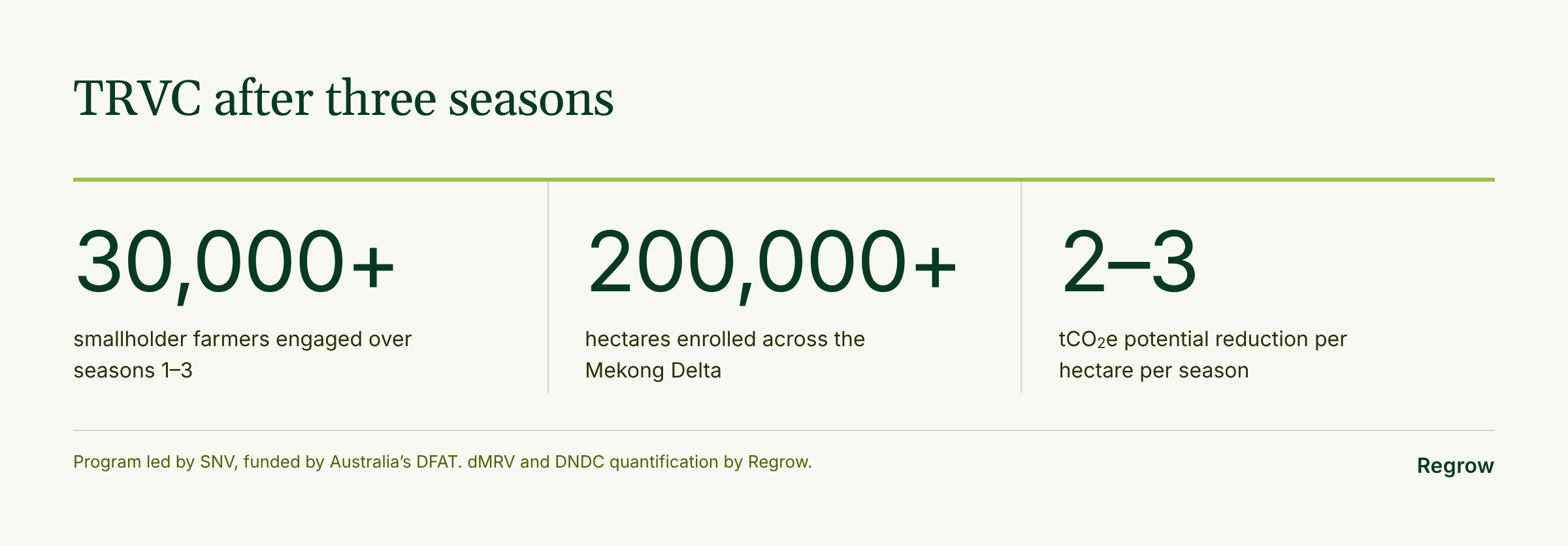
After three seasons, five lessons stand out:
- Smallholder farmers can be engaged at scale. TRVC is working with tens of thousands of smallholder farmers. Group-based registration, a trained network of field agents, and bulk enrollment tools made it possible to reach this scale while keeping the per-farmer cost of MRV low.
- Emissions reductions and better livelihoods go together. The program is delivering significant GHG emission reductions while improving farmer livelihoods, with farmer profit margins increasing by 40–60%, and advancing gender equality, disability, and social inclusion (GEDSI) outcomes.
- dMRV makes scale possible. Verifying practice change on tens of thousands of fields through site visits alone would be too slow and too costly. TRVC's dMRV system was refined season by season, with improved enrollment workflows, stronger QA/QC, and better remote sensing calibration, to fit both carbon market requirements and the realities of smallholder farming.
- Tier 3 quantification provides robust results. Emission reductions are quantified with DNDC, a Tier 3 biogeochemical model calibrated against chamber measurements from the region. DNDC accounts for both methane and nitrous oxide, and Monte Carlo analysis produces crediting ranges that robustly account for uncertainty.
- Rice is a key solution for mitigation and adaptation. TRVC demonstrates that voluntary carbon market and Article 6 programs for rice can deliver significant impacts: GHG reductions, stronger farmer livelihoods, and better use of water resources. For a delta facing drought and saltwater intrusion, those adaptation benefits matter as much as the emission reductions.
Vietnam is leading the way into COP31.
As countries gather in Antalya for COP31, Vietnam stands out as a leader in low-emission rice. Its national program to develop one million hectares of high-quality, low-emission rice in the Mekong Delta by 2030 sits alongside its commitment to reduce methane emissions by 30% by 2030. Programs like TRVC show how that ambition can connect to Article 6 cooperation and to buyers willing to pay for verified results.
For other rice-producing countries, Vietnam's experience offers a clear lesson: a credible national rice strategy needs an MRV system that works at the scale of smallholder farms, meets international standards, and serves both voluntary and compliance markets.
On November 9, Vietnam will host an event at COP31 on its One Million Hectares program for high-quality, low-emission rice, and will highlight TRVC as an example of what the program can deliver. If you are in Antalya, we encourage you to stop by to learn more about the program, the results to date, and how farmers, governments, and buyers are working together to scale low-emission rice.
Rice is a solution, not just a problem.
In 2023, we wrote that unlocking climate finance is the key to scaling climate-positive practices in the rice sector. Three years on, the evidence is in the field. Digital MRV has helped build programs that reduce emissions, improve farmer livelihoods, and use water more wisely, and buyers and governments are investing because they can trust the results.
The work is far from finished. Rice is grown on more than 160 million hectares worldwide, and much of it is still continuously flooded. By continuing to invest in measurement, partnerships, and smallholder farmers, we can make sustainable rice production the norm rather than the exception.
Explore our MRV and get in touch to learn how Regrow can support your rice program.
SOURCES
- Regrow: Unlocking Climate Finance for Sustainable Rice Production (2023)
- Amazon Sustainability Exchange: Superpollutant abatement, rice methane credits
- Axios: Google, Amazon, others team to cut climate superpollutants (March 2026)
- ESG Today: Amazon signs 685,000 ton carbon credit deal (April 2026)
- WBCSD: Regrow selected as independent verifier for the Mekong Delta rice initiative
- VietNamNet: Vietnam to develop 1 million ha of low-emission, high-quality rice by 2030