Subscribe to our newsletter
This conversation was originally recorded for Innovation Forum's Sustainable Business Podcast, hosted by Ian Welsh. It has been edited for length and clarity.
When the supply chain breaks
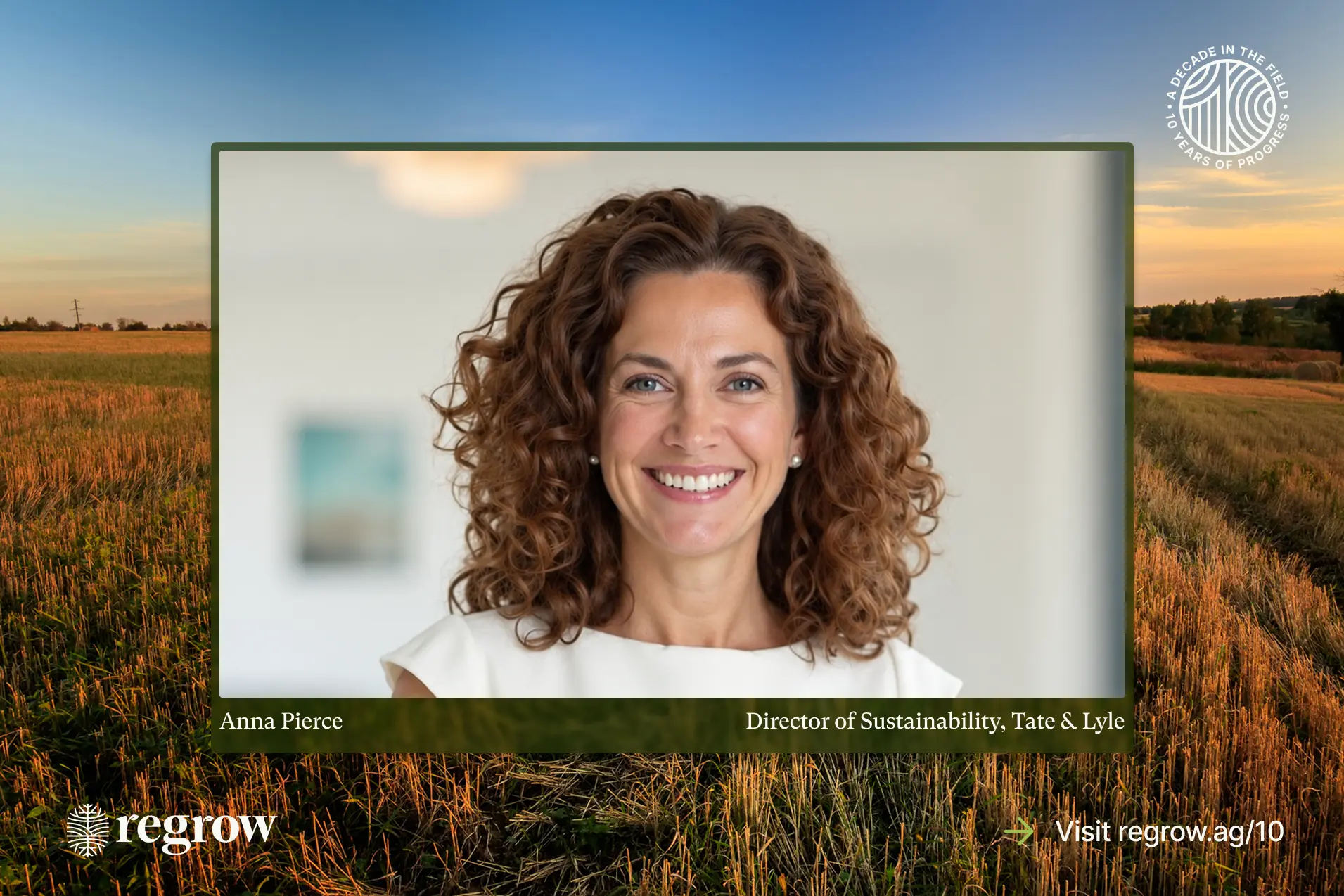
In 2022 and 2023, widespread drought in France impacted the entire agriculture industry including Tate & Lyle’s corn supply chain. As a result, the company shipped corn from its US suppliers to its European facility for processing. "Not the most sustainable process when we think about transportation footprints," Anna said, "and not the way we want to run the business. We want to operate locally with our local suppliers."
That disruption made it clear: Tate & Lyle needed to increase supply chain security and offer better protection from climate shocks.
Tate & Lyle’s solution was to extend its regenerative ag program, which began in the US for corn in 2018, to France, an important corn sourcing region supplying the company’s European production facilities.
The company launched a program in France in 2024, starting with a little over 4,000 acres. By 2026, enrollment had grown nearly threefold to 11,000 acres.
Operating a regenerative agriculture program for many years has taught Anna a few key things about regenerative agriculture:
- Regenerative agriculture is a tool for business continuity, not just an impact program
- Start small, and let farmers see results before scaling
- Without data, a program is just a good story
From impact to business continuity
Tate & Lyle acquired ingredient producer CP Kelco at the end of 2024, which expanded its product portfolio and agricultural footprint. The company spent most of 2025 updating its climate, water and nature risk assessments, then finished with a double materiality assessment.
That work changed how the rest of the business saw regenerative agriculture.
"Historically, we've done a really good job of talking about focusing resources for impact," Anna said. "But there's a different side of that discussion, which is focusing those resources to ensure that there is business continuity.” In other words, companies are good at funding programs with clear impact goals, like reduced emissions. Now we need to learn to use those resources to ensure supply security and support the regions where companies get their ingredients.
For much of the past decade, that wasn’t how regenerative programs were justified inside large food companies; they were reduced to emissions reductions, a positive story for stakeholders and a line in the sustainability report. All important, but risk assessments are now moving the conversation to finance and procurement. Consider the sourcing issues Anna described in France: the company had to ship corn from US suppliers to cover losses in France. This is a costly adjustment, and these types of adjustments are only likely to increase in cost and frequency.
Once finance and risk teams had to calculate the financial impact of situations like this, they started seeing regenerative agriculture as a procurement responsibility instead of a sustainability function.
"It's an evolution of the sustainability function," she said, "that we're more than a do-good impact organization."
From Regrow's perspective, this is what sets the program apart. Anna brought Tate & Lyle's commercial and procurement leadership into conversations early, so the program was built around supply security and customer relationships from the start, not added to a CSR report afterward.
Another thing that sets Tate & Lyle apart is its acknowledgement of the risks farmers bear when they agree to participate in a regenerative program. These programs, which can be sold as risk reduction methods for downstream companies, often come with significant upfront risk for farmers.
Asking farmers to bet their livelihoods
Anna is realistic about what a regenerative program asks of farmers. Some are being asked to farm differently than their families have for generations, and the results won't show up in a single season.
"We're literally asking farmers to bet their family's livelihoods on the solutions that we're providing, and that's not a small request."
That means the economics have to work for farmers on their own terms and the solutions have to be proven and targeted." Our suppliers can't just be working in these programs because Tate & Lyle said so," she said. If a practice isn't financially viable, farmers will eventually go back to what they did before. Tate & Lyle sees its job as supporting farmers through the transition period.
Start small and let the results travel
Before enrolling a single acre in France, Tate & Lyle and Regrow's agronomists held workshops with participating cooperatives and their farmers. The goal was to get feedback before the program was finalized, not to present a finished package.
"They want to be part of the conversation, and oftentimes are the best subject matter experts when it comes to trials and tribulations of the past, what worked and what didn't work," Anna said.
That's a departure from many of the industry's early programs, where a buyer designed the practices and asked farmers to sign on. Anna described the approach she wanted to avoid: showing up with "this really packaged program and saying, everyone's doing this tomorrow and it's going to be fantastic. Because oftentimes, it's just not the case."
The first-year results gave cooperatives something concrete. Emissions from participating farmers came in 19% lower than the surrounding supply shed. Then other farmers and cooperatives started asking how to join.
"That word of mouth groundswell is a real demonstration of success," Anna said.
Starting too large carries a risk: "You lose that individual connection with the participating cooperatives and the farmers, and they feel like they're part of this huge machine. And that's the opposite of what agriculture programs should feel like."
Starting small also left room for honest conversations. Some farmers wanted to adopt practices that didn't suit their geography, and the team told them so. "You don't want people blindly signing up for programs just because their customers are asking them to," she said.
Seeing is believing at the fence line
Tate & Lyle also runs a regenerative program for stevia with smallholder farmers in China, which is reaping benefits for participating growers. Partway through onboarding, a flood hit. On one side of a fence line sat a field farmed with cover crops and reduced nutrient inputs. On the other side was a conventionally farmed field. The team saw a clear difference between the two fields; the regenerative field managed the excess rainwater much better than the conventional field, and crops sustained significantly less damage. This showed the team that, indeed, regenerative programs reduce risks for both producers and companies in the long run.
In the end-of-year survey, every participating farmer said they were now concerned about climate change. Previous surveys hadn't shown that. The following year, 100% of farmers in the program followed the full set of practices.
Anna highlights that, while companies are thinking about greenhouse gas emissions and soil health, farmers are most concerned about the effect of regenerative practice on their annual revenue and bottom line. For many growers, seeing yields hold up on regenerative fields is the strongest case for investment.
Data turns the story into a business case
For Anna, measurement is what separates a lasting program from a pilot. "Without the data, it all becomes this feel good program," she said. "We can all be really good storytellers, but at the end of the day, that doesn't always add up to investment and change that we want to make."
The program in France shows how this works in practice. Tate & Lyle paid for the first year on its own, because few customers will fund a program before it has results. "Thankfully, we had a good year. We had really great data. We saw increased participation and our customers have opted in," she said.
Yield stability is a large part of that case. In other grain supply chains, Regrow has found that regenerative fields roughly halved yield variability in drought years, from 37% to 18%. For farming operations that run on tight margins, a swing that size can be the difference between a profitable year and a loss.
No one can do this alone
Though Tate & Lyle funded the first year of its program solo, Anna doesn't think company-by-company programs can carry the transition on their own.
"The regenerative agriculture approach cannot be a thousand little companies with their suppliers and their customers, funding projects forever," she said. "There has to be a public-private partnership in that we're defraying the cost of building a food system that can feed a growing population."
That's a long way from where corporate programs began, with a single company funding a pilot with its own suppliers. Anna advocates for taking a landscape-level approach, where companies sourcing from the same region co-invest in shared programs. In Europe, the EU's Carbon Removals and Carbon Farming (CRCF) framework could help match private buyers with public funding.
Looking ahead
Over the next 12 months, Anna wants to see this year's results from France, gather farmer feedback, and keep expanding. Customers who were hesitant at the start are now engaged. "As we see more engagement, we see programs like this scale," she said. "Without it, we're all stuck in a small trial pilot pattern."
The industry spent ten years learning how to build programs like Tate & Lyle’s that farmers trust. The next few years are about building enough of them, quickly.
–
Want to learn more? Check out the rest of our A Decade in the Field → series, and stay tuned for new interviews.