Contributors
Subscribe to our newsletter
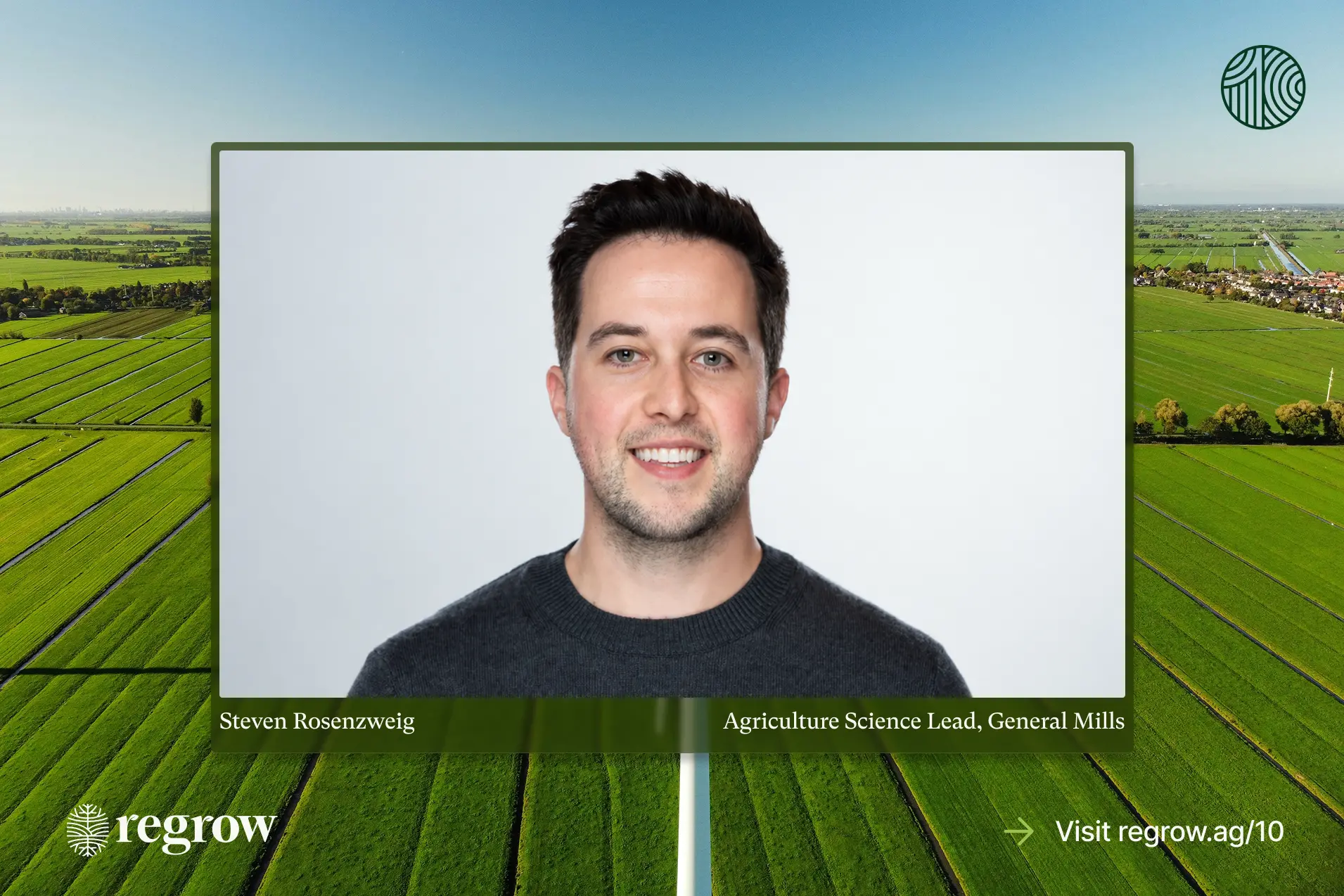
Steve Rosenzweig's path to General Mills started with a passion for soil health. As a Ph.D. candidate in Soil and Crop Sciences, Steve studied the link between soil health and farm economics, and the sociology of how farmers in dryland cropping systems actually make decisions.
Today, Steve is applying those learnings and over a decade of experience to General Mills’ agriculture initiatives, partnering with farmers and local partners to support adoption, and researching the impacts of regenerative agriculture on soil, water, biodiversity, climate, and farm economics across the company's key sourcing regions.
Steve’s experience spans both the science and the human decision-making behind food production, and it shaped everything he shared in our conversation for our Decade in the Field series. In our discussion, he shared the business case for regenerative agriculture, what better data has changed about the conversations Steve is able to have, how he defines success, and what it will take for the industry to start investing in regenerative agriculture as a long-term business strategy.
Here’s our Q&A with Steve Rosenzweig:
Q: Ten years ago, the business case for regenerative agriculture often centered on achieving climate goals. Today, it's increasingly tied to supply chain resilience and long-term business value. From your perspective, what has driven that shift?
A: For us, regenerative agriculture serves two connected imperatives: building resilient agricultural value chains and delivering widespread climate impact. Resilience has been a key priority in our regenerative agriculture work from the beginning. We need resilient farmers and ecosystems to be a resilient food company. One thing that has evolved is our understanding that the most effective path to both climate impact at the farm level and long-term business resilience is grounded in farmers' and local stakeholders' needs and priorities.
In some contexts, it makes sense to focus on climate impact because it resonates with farmers and other stakeholders. In others, the motivating issue for stakeholders is something else; for example groundwater decline in Kansas. So that is the issue we focus on there.
Individual targets remain important for accountability and momentum, but no single company can create resilience on its own. Ultimately, resilience comes from collaborating to address the place-based and systemic risks to agricultural production that affect farmers, communities, value chains, and food companies alike.
Q: General Mills has consistently invested in regenerative agriculture while also advancing the science behind measuring outcomes. How has better data changed the conversations you're able to have internally with business leaders and externally with farmers and partners?
A: For us, better data has made the conversation more specific and nuanced, which has also improved our strategies and made us more effective. It has helped us move beyond broad assumptions about regenerative agriculture and toward a clearer understanding of which outcomes appear, under what conditions, and why.
Internally, that gives us a stronger basis for conversations with business leaders. We can discuss which outcomes matter most in a particular landscape, what evidence supports them, and where important uncertainties remain. Externally, the conversation with farmers and partners is often not about regenerative agriculture broadly, but about what our shared challenges are and what is working in a given cropping system and geography.
It also lets us demonstrate how our strategies are informed by scientific insights. For example, research we partnered on with Furman University and RES shows benefits from specific practices for bird biodiversity. It also shows that those benefits can vary by species, and that regenerative agriculture on croplands works best alongside other strategies, such as grassland conservation, to support grassland birds. As a result, we have also supported grassland projects as part of a more holistic strategy to address biodiversity risks in the Great Plains.
At the same time, better data has made us more careful about how we talk about outcomes. Weather and other natural forces shape results in powerful ways, so the story is rarely straightforward. That is why we try to understand regenerative agriculture from multiple angles: farmer and agronomist observations, longitudinal studies on working farms, economic and social research, broad observations through satellite imagery and modeling, and more controlled university studies. Soil carbon is one example of a knowledge gap: we still need more long-term studies of soil carbon change across large numbers of real working farms.
So, better data has given us more confidence to act where the evidence is strong, and more precision and caution where the evidence is still developing.
Q: One of the biggest lessons over the past decade has been that regenerative agriculture is about increasing resilience, water quality, biodiversity, farmer profitability, and securing future supply. How has your definition of "success" evolved as your programs have matured?
A: Our definition of success is not so much about what General Mills can say about its own impact, but about the broader change we are working toward in each supply shed. It is about working collaboratively toward the larger challenges affecting everyone in the landscape and finding solutions that create shared value.
To know what success looks like, we first need a theory of change for that landscape: what we are trying to achieve, how we believe change will happen, and which outcomes matter most. In many cases, success sits at the center of a Venn diagram of the shared priorities of farmers and value chains, the environment, and local communities.
Q: Looking ahead, what do you think will finally make regenerative agriculture an obvious business decision rather than a sustainability initiative? What still needs to change over the next decade?
A: A Social Return on Investment analysis we conducted with Ecotone suggests that regenerative agriculture can create shared value well beyond food companies: in the Cheney Lake Watershed, it projected approximately $189 in additional social, environmental and economic value per acre per year against $38 in additional cost. That’s about $5 in value for every $1 invested, and that value reaches a large and diverse set of stakeholders. Because these benefits cross organizational and geographic boundaries, the study points to the need for government, corporate and community partners to share in supporting adoption.
The goal is unlocking all these benefits in ways that are economically beneficial and durable for farmers. If we can connect farmer prosperity, supply resilience and improvements in natural systems, regenerative agriculture will no longer sit at the edge of the business. It will be part of how a resilient food company operates.
---
About Steve Rosenzweig
Steve Rosenzweig is Agriculture Science Lead at General Mills, where he has worked since 2017. He holds a Ph.D. in Soil and Crop Sciences from Colorado State University, where his research examined the link between soil health and farm economics and the sociology of farmer decision-making in dryland cropping systems.
Learn more about the past and future of regenerative agriculture in our series, A Decade in the Field →