Contributors
Subscribe to our newsletter
The invisible link
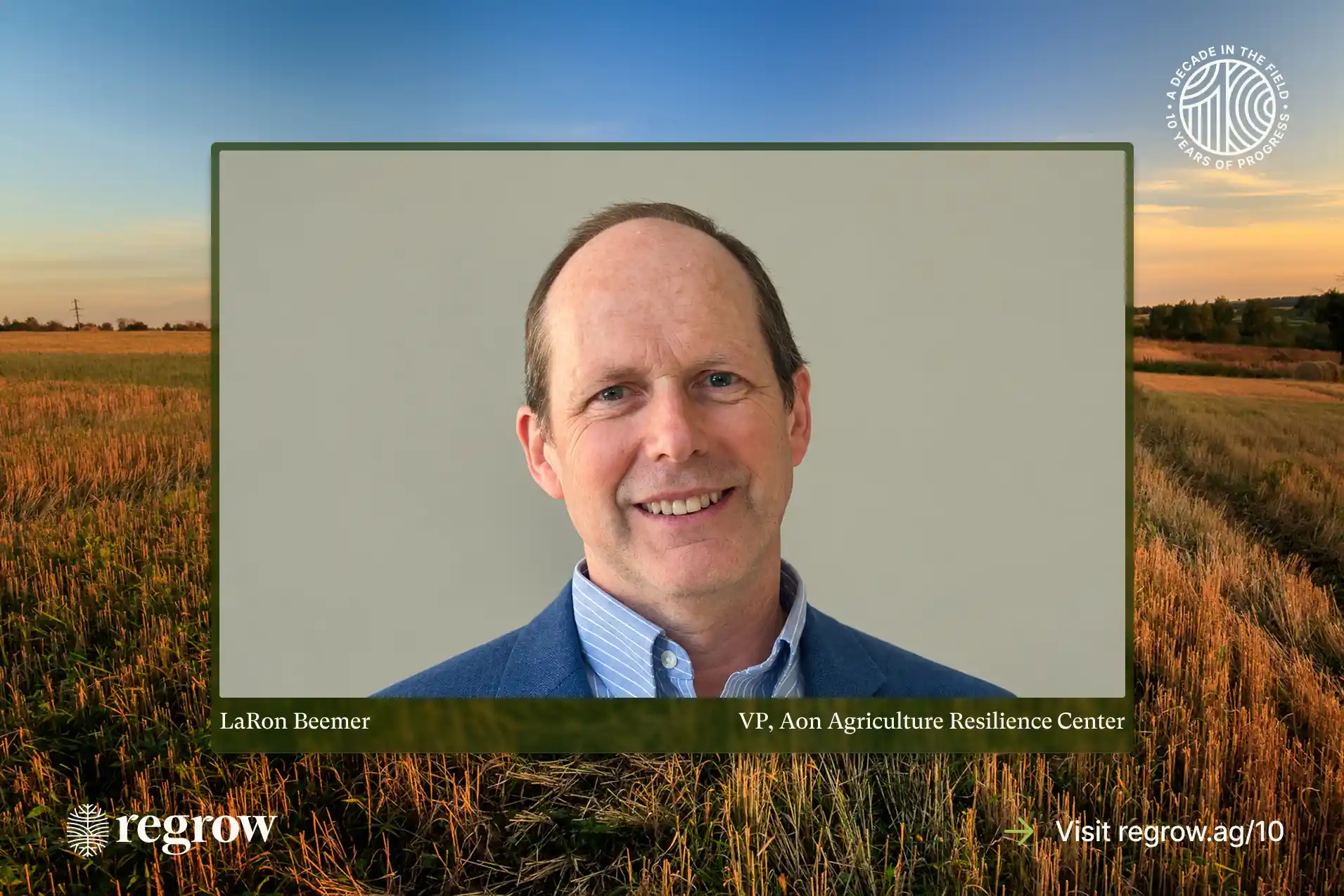
LaRon has seen agriculture from more angles than most. He started as an agronomist and doubled the carrying capacity of his own farm through rotational grazing, then moved into financial consulting before spending twenty years in finance and marketing at Corteva. Each role gave him a different view of the same system.
Through all of it, one connection stayed hidden from him.
"I didn't understand risk capital, and I didn't understand resilience and that these could all come together," he said. "It was just invisible to me."
At Aon's Agriculture Resilience Center, he's now working to make that connection visible to farmers, insurers and investors.
Resilience depends on where you sit
Part of what makes "resilience" useful framing is also what could make its meaning drift: everyone supports it. Nobody argues against being resilient, but people mean different things by it.
LaRon's way of keeping the word honest starts with a plain definition: "the ability of a system to absorb stress and keep functioning."
What that looks like depends on who you ask. For a farmer, yields hold up through a drought. For a lender, the borrower stays viable through volatility. For a food company, supply stays steady in the face of climate and economic disruption. For an insurer, losses become more predictable, less frequent and less severe.
A definition helps, but what will keep resilience from becoming a buzzword in the decade to come is measuring it, and that's the work LaRon is doing at Aon. He points to what credit scores did for lending: once lenders could score borrowers, debt markets lent more money, on better terms, to better risks. As he put it, "If I can put a risk score on that, you're a better risk, and I can loan you more money."
Risk capital goes first
LaRon breaks capital into three kinds. Equity buys part ownership and debt lends money, but risk capital, which includes insurance, works differently: it takes on the losses when something goes wrong, so the other two are free to move.
His example is a car loan.
"If you want to buy a car, the bank's going to loan you money; that's debt capital. What does the bank say? Do you have insurance?" For the bank to be willing to lend, someone else has to carry the risk of a crash.
Farming works the same way. A farmer who changes practices takes on new risk, and "a rightful question they would have is, OK, well, who pays for this?" For money to flow toward new practices at greater scale, someone has to be willing to understand and carry that added risk. Until recently, the institutions that carry it had limited ways to measure resilient practices well enough to price them.
A system built with a different goal in mind
Conventional crop insurance doesn't necessarily recognize the risk implications of years spent building soil health or other resilience practices, but LaRon doesn't blame the federal program for that.
"The crop insurance system in the U.S. was set up to help farmers recover from losses. Does it do that? Yes, it does that very well," he said. "Does it recognize the resilience component? No. It wasn't designed to do that, and frankly didn't have the tools to do that."
He wants to build on the existing system, not tear it down: "Not saying replace it, but add to it, supplement it, increase options."
For farmers, the gap is personal. Health insurers ask whether you smoke, and auto insurers ask whether you drive safely, but crop insurance has had limited ability to ask how a farmer treats their soil. When farmers finally see years of that work show up in the data, LaRon said, the reaction is emotional: "I am being seen for what I've done. And that is a powerful thing."
That kind of recognition is often missing from Scope 3 programs. Many are built to reward new practice change, which can leave out farmers who've already adopted soil health building practices. Creating economic mechanisms around resilience could offer a way to recognize work that's already been done, alongside the new acres those programs bring into the transition.
Select the risk, price it, and control the loss
US farmers have had access to federal crop insurance since 1938, so agriculture is hardly new to insurers. What struck LaRon when he moved into insurance, however, was how hard it had been to bring field-level agronomic resilience into underwriting. An insurer selects a risk, prices it, and puts loss controls in place, but for resilience, he said, "we really haven't had the tools to do that."
Part of the reason is that soil is a complicated, living system; in LaRon's words, "We know more about outer space than what's underneath our feet." What is known is scattered across field records, studies and reports, and stitching it together field by field has been too slow and costly to do at scale. Advances in data, geospatial technology, modeling and AI are beginning to change that, making it possible to pull that information together, tag it to individual fields and run simulations from it.
From Regrow's research: We've seen the same shift at Regrow. Our yield stability research asked whether regenerative practices make yields more resilient in drought years. To answer it, our Ag-gentic platform pulled more than 20 data layers into a single record for each field and season, then analyzed about 152,000 crop cycles. Data assembly that once took months of engineering can now be completed in a fraction of the time.
As those tools mature, resilient practices start to look like what they are: loss controls. If credible evidence shows that particular practices affect loss performance, insurers could incorporate that information into risk selection, pricing or product design. LaRon is optimistic, but careful not to oversell where things stand today: "I wouldn't say that we've arrived."
Pilots don't scale without reinsurance
Insurers look at a specific field and crop, while reinsurers, the capital behind the insurers, look at larger portfolios: slices of risk spread across geographies, crops and years. That's why a pilot with one insurer can work well and still never grow. "We could have lots of interesting pilots that stop at the insurer level, but then they will never scale," LaRon said.
Reinsurers generally need credible evidence, sufficient data and confidence in how a risk behaves before supporting it at meaningful scale. Once they have that, they can back the insurers writing those policies, and the insurers can then offer coverage to farmers at scale. As LaRon put it, "reinsurance capital flows to the insurance, which then flows to the risk."
Data fragmentation remains a key problem: crop systems and climate stresses vary from one region to the next, and the data needed to model them is split across many organizations. A model can be strong in one well-studied area and weak in another. Bringing that data together in a form reinsurers trust is one of the biggest jobs left for the industry.
Every part of the agricultural value chain has data to contribute, but what's still being formed, in LaRon's view, is a shared picture of what that data could make possible. "The vision first has to exist," he said.
From what happened to what's likely to happen
LaRon sees MRV as a crucial starting point, because it answers what happened on a field. The next step is turning that same data into risk intelligence, which can assess what's likely to happen next and simulate what could. "You have to have the data. That's why that MRV component is very critical," he said. "Then what else can we do with it?"
Carbon outcomes have been the industry's main focus for "a decade, decade and a half," but LaRon sees another side to it: what carbon actually does in the soil.
He starts with water. About two thirds of crop losses are water-related, he noted, too much or too little, and USDA data bears that out: since 2000, drought and high temperature have accounted for about 41 percent of federal crop insurance indemnity payments, and excess moisture for about 27 percent. Soil organic matter and good soil structure help fields absorb heavy rain and hold water through dry spells. LaRon's shorthand for that is a sponge.
"I'm interested in carbon in the soil, building the soil carbon sponge," he said. "As you build that sponge, you're more resilient."
That thinking fits a broader shift in corporate sustainability towards measuring outcomes beyond carbon, like water, biodiversity and soil health, using data that's already being collected. It fits, too, with one of the things food and beverage companies care deeply about: a secure supply of raw materials at a predictable price. "If you can assure me a steady supply, that's resilience," LaRon said. But getting there means asking farmers to change, and as he put it simply, "change is risk."
Looking ahead
LaRon compares this moment in agriculture to Moneyball, when data fundamentally changed how baseball valued players. Better data and better science lead people to ask better questions, and the answers can pay off for everyone in the chain. Farmers are seen for their practices, and supply chains, communities and the environment all benefit.
The destination isn't simply cheaper insurance for healthier soil. It's agricultural information turned into credible risk intelligence, which helps risk capital tell one risk from another. Risk that's better understood can give farmers more options and freedom to operate.
Everyone in the chain already wants resilience; what's left is measuring it well enough that the people who carry the risk can price it.
Want to learn more? Check out the rest of our A Decade in the Field series, and stay tuned for new interviews.