



Subscribe to our newsletter
To understand the history of a single farm field, you need data from many sources: satellite imagery, weather, soil properties, drought records, and farmers’ own records.
Each comes from a different system, at a different resolution, on a different schedule, and with different limitations. Clouds block satellite monitoring. Weather data doesn’t map easily to a field boundary. Farm records are kept to run a farm, not to do environmental modeling.
Assembling that data has historically been slow and labor-intensive, with time and resources going to data plumbing (moving, cleaning, and joining data) instead of insight and action. Across the millions of acres in a global supply chain, that overhead adds up. Every month spent preparing data is a month that farmers, food companies, and lenders wait to act on what it shows.
That’s why Regrow built Ag-gentic, an AI agent platform designed to let agents build, run, and maintain Regrow’s various data pipelines. Handing the tedious work of data assembly to agents shortens our customers' time-to-insight by letting our team focus on what we do best: science. That means asking the right questions, building better models, and making sure everything we deliver holds up to scrutiny.
Ag-gentic: a rebuilt foundation for agents
While every company is adding AI features to their products, we're leveraging it a level deeper to actually build the foundation on which those products depend.
That means we couldn't simply plug AI into the pipelines we already had. Imagine dropping a robot onto an assembly line built for people and expecting it to know how to work. In reality, the entire line has to be redesigned around what the robot can see and do.
Data pipelines are the same. So rather than retrofit our existing pipelines, we built Ag-gentic’s from the ground up for an agent to run. Each pipeline is a chain of small individual steps, like pulling satellite imagery, masking out clouds, or matching weather data to a field boundary, and every step follows four rules:
- One job each. A step does one thing only and documents what it expects and what it produces, so an agent can easily understand it on its own.
- Self-checking. A step checks its own output for completeness before passing it on, so gaps are caught before data reaches a model or a customer.
- Safe to re-run. If a step stops partway through (say, a data source times out), it can be restarted. It picks up where it left off without duplicating or corrupting finished work.
- Cost known up front. Before a run starts, its cost is estimated, so large analyses can be budgeted with no surprises.
Every pipeline feeds a single standardized record for each field and growing season, with remote sensing, weather, drought, soil, and farm-reported data all in the same structure. A yield model, a deforestation check, a climate risk report, or even a customer’s own modeling can all draw on that same record, so results line up across products instead of needing to be reconciled.
The code itself is written by AI, too. In the last six months, the Ag-gentic codebase has grown through more than 105 merged pull requests, each written by agents. AI writes and runs the code, but Regrow’s team of scientists own the results. Human review remains crucial to ensure that the outcomes we deliver are both actionable and auditable.
Working with agents does have its lighter moments. One of our engineers jokes that he set Ag-gentic up so he could run a pipeline via text thread from his couch. Cleaning climate data has never been so efficient (or comfortable!).
What it powers today
In just a few months, Ag-gentic has gone from supporting one research prototype to running five very different kinds of sustainability products.

Case study: yield stability research
Regrow's yield stability work asks whether regenerative practices make crop yields more resilient, especially in drought years. Food companies, agribusinesses, lenders, and insurers all want the answer, because yield volatility is a procurement and financial risk as well as an environmental one.
Answering it means joining every kind of data described above, and more, for every field and every season, at supply shed scale. In the past this would have required months of engineering before a data scientist could even start on a model.
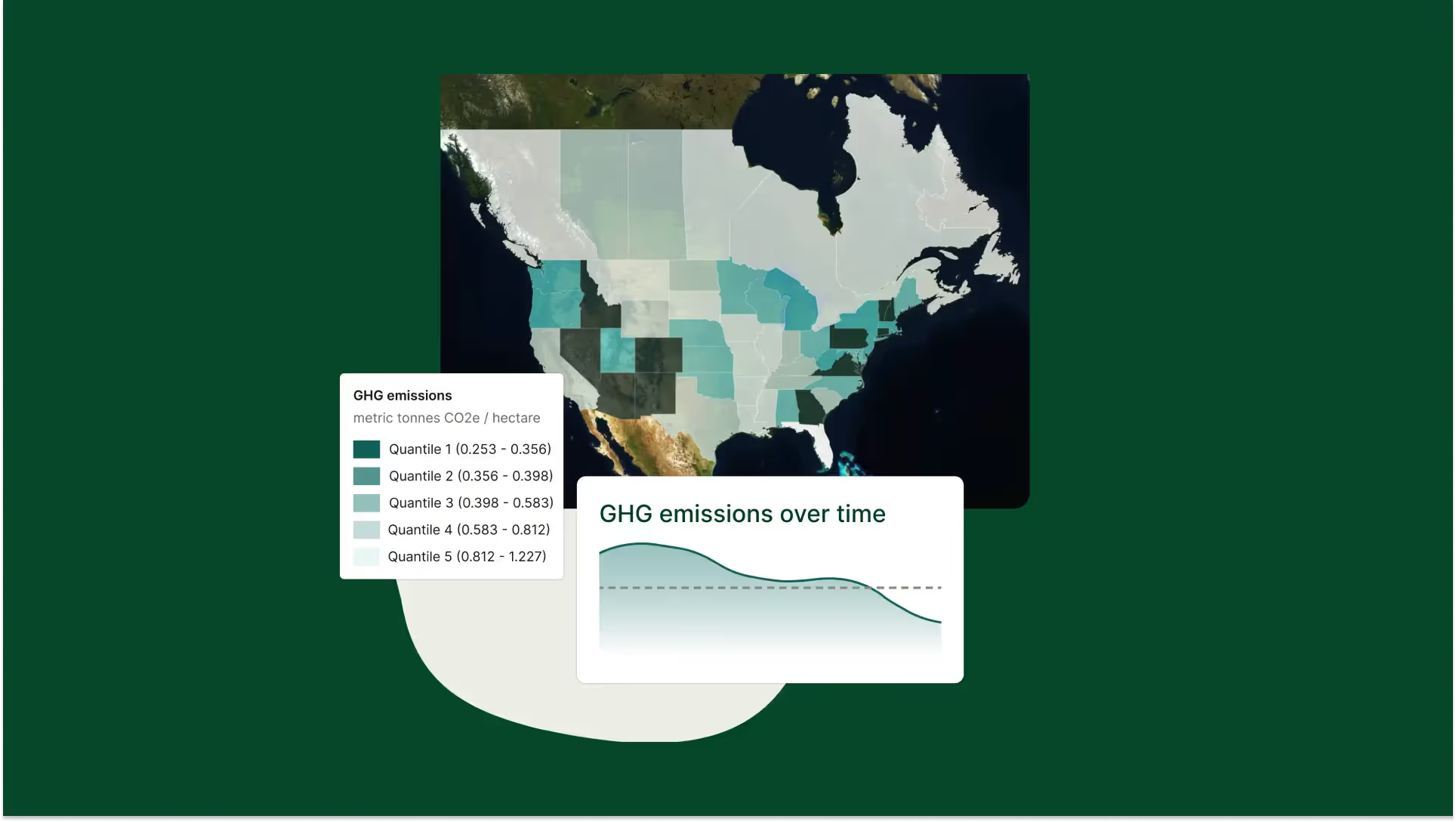
Ag-gentic automated that assembly, pulling more than 20 independent data layers into one standardized record per field, per season, so the research team could go straight to modeling. Because every step checks its own output and can be safely re-run, the team could iterate quickly and trust the data underneath.
It also changed what the work costs at scale. A redesign of how one nationwide data layer is computed cut its processing cost by about 60x. An approach that once only made sense for a pilot can now run across the country.
The result was a working prototype that analyzed about 152,000 crop cycles, linking regenerative practice adoption to yield outcomes and soil carbon change. Our team built it in one quarter, and the same foundation can now be extended to new crops, regions, and questions.
We're so excited by this progress that we've opened a call for industry partners to engage with this methodology and make it stronger, together. Read more about our yield resilience coalition here.
Let's build together
The data layers Ag-gentic produces power Regrow's Agriculture Resilience Platform and are also accessible via APIs. Agribusiness and supply chain teams can build their own sourcing, risk, and reporting products on top of them, using field-level intelligence that has already been assembled and checked.
Faster pipelines also mean faster custom work. When you need a new region, a new crop, or a new question answered for your supply shed, Regrow starts from pipelines that already exist rather than from scratch.
If your team's work could be enhanced by field-level intelligence, we want to hear from you.