

Contributors
Subscribe to our newsletter
An unlikely path into agriculture
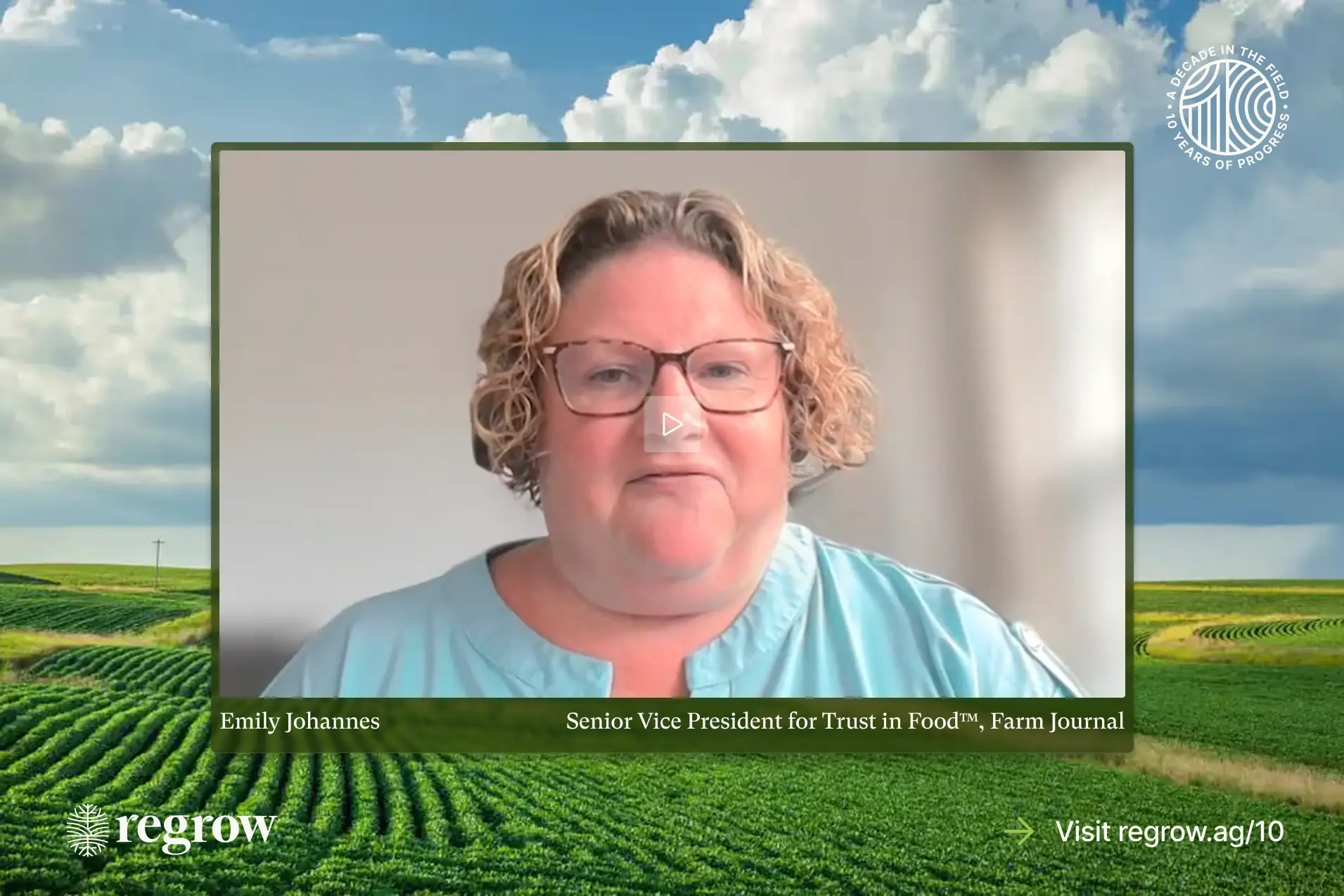
Emily spent her first decade in environmental and regulatory compliance for federal agencies, including the Department of the Navy and the Department of Veterans Affairs, before a mentor encouraged her to move into the ag policy and climate work taking shape in the 2000s.
"I always joke that I wasn't a very good auditor," she says. "I didn't like pointing out problems and then not being able to help people solve them."
Making the switch meant admitting what she didn't know. "I remember a conversation with my mentor at the time, telling her, 'But I don't know anything about agriculture. I didn't grow up on a farm,'" she recalls. "She had the confidence in me to learn it."
She started in the dairy industry in the late 2000s, sitting in on some of the first discussions about how to bring farmers into sustainability programs. She describes that work as mostly paperwork and meetings: unglamorous, but foundational. She later worked on the buyer side at Nestlé North America before joining Farm Journal, where she now leads Trust in Food™.
Starting as an outsider still shapes how she works with farmers today. She's open about what she still has to learn, and she holds herself to one rule before asking anyone for input.
"Before you ask any stakeholder 'what do you want,' ask yourself: can I actually satisfy that need once they tell me? If you can't, don't ask the question."
Farmers, NGOs, and food companies now share the room. The systems around them are still catching up.
Emily has watched the relationship between farmers, nonprofits, and food companies change over two decades. Twenty years ago, she was often the farmers' voice in conversations they weren't part of. Today farmers are included earlier and more often, and groups that used to work separately are better connected. A farmer working with Ducks Unlimited, for example, is now more likely to see how that work connects to a food company's program.
What hasn't caught up, in her view, is the infrastructure for collaboration across the supply chain. Procurement is a decades-old process built around contracts, prices, and terms, and it wasn't designed for something as relational as continuous improvement in soil health.
"Negotiating a supply contract is very different from working together to drive continuous improvement," she says. "I don't think any of us want regenerative agriculture and conservation improvement to become purely transactional."
She has respect for the people working on the necessary transformation of these systems, but in her role, she can’t afford to wait. "As someone who works on the ground with farmers, I just want to get things done for them right now," she says. That means working with procurement as it is and adjusting it where possible.
Closing the gap starts with knowing who's ready
Emily sees data and insights doing real work here, because what procurement and supply chain teams need most is predictability.
"You would never enter a supply-shed relationship not knowing whether your supplier can actually supply the goods," she says. Yet that's essentially what early regenerative agriculture programs asked companies to do: commit first and trust that the outcomes would follow.
Better data changes that. Imagine knowing from the start that 70% of the farmers in your supply shed are willing and able to change practices in the next year or two. Or that 20% are ready now, while another 30 to 40% need more help. A company with that information can put its resources where they'll do the most good, instead of treating farmers as one uniform block. Emily sees that demand for upfront visibility as a sign the industry is maturing.
Reaching farmers faster
The math on trust is sobering. It typically takes two to five engagements to build real trust with a farmer. A study Farm Journal conducted with Reach Farmers Faster found that, at today's pace, reaching farmers at scale would take 400 years.
Part of the problem is awareness. At a recent Farm Journal event in Iowa, 85% of the farmers who attended learned about something they hadn't known about before. "We have a tendency to over-predict the general awareness of the agricultural community," Emily says. Conservation opportunities rarely appear in mainstream ag media, which leads with ag tech, machinery, and farm economics, just as a food company's media focuses on consumer preference and competitive pressures.
Reaching the right farmers with the right message changes that math. The two to five engagements may not go away. But when farmers arrive already aware and interested, advisors spend far less time on the basics. By her estimate, the 12 to 20 hours of relationship-building each farmer used to need can be cut in half, or more.
Getting the message right may mean leaving certain words out. Many of Farm Journal's most successful campaigns and events don't use "sustainability" or "conservation" at all. Instead of promoting reforestation, a campaign might say "make money planting trees." "At the end of the day, it's about farmers being economically viable, doing what they already do well," she says. In her experience, awareness of the conservation benefit follows the economic case.
Funding swings are a trust problem, and a case for a more diversified capital stack
Emily is direct about how recent funding volatility has affected farmer trust, from last year's pause in Climate-Smart Commodities funding to a visibly reorganized USDA.
"We all leaned into that opportunity," she says of Climate-Smart Commodities, "and then the political winds shifted, as they do in Washington." In hindsight, the lesson was one the conservation community hadn't absorbed. "We'd always had that mindset about private business and capitalism, but we hadn't applied it to conservation funding. We just hadn't."
Rather than waiting for public funding to stabilize, she wants the industry to stop treating grants as the whole financing picture. Most farms run on operating loans and crop income, with conservation payments usually a small slice therein.
What excites her is that banks, lenders, and insurers are starting to connect conservation to what's usually top of mind for a farmer: their loan. "Even a great premium on one side may never solve a farmer's loan situation on its own," she says. Grants, premiums, outcomes-based payments, and carbon credits don't have to go away. Paired with benefits on the operating-finance side, they have a much better chance of making the economics work.
A decade of pilots has produced real demand
What Emily sees on the ground gives her hope: more farmer interest than current programs can support. Now the question becomes capturing it and sustaining it.
"A decade ago, we were in a pull mentality: 'please come, please start doing this,'" she says. "We're in a demand mentality now." When Farm Journal brings its awareness campaigns and events to a region, hundreds of farmers show up, and existing programs are oversubscribed. Farmers are also asking how to combine and stack programs to fit their own operations. Those choices used to be made for them by people outside agriculture. Now farmers are the ones asking the questions.
For Emily, this is the clearest sign that a decade of pilots and relationship-building is working. The next job is stacking and simplifying: making the path simple and clear enough to meet the demand that's already there. "It's about getting the right people to the right opportunities at the right time," she says. "I think we'll see some great uptake in how this plays out across the US in the next decade."
-
Want to learn more? Check out the rest of our A Decade in the Field → series, and stay tuned for new interviews.
.webp)
%20(1).webp)