
.webp)

Contributors

Subscribe to our newsletter
Decades of conservation work highlight three priorities
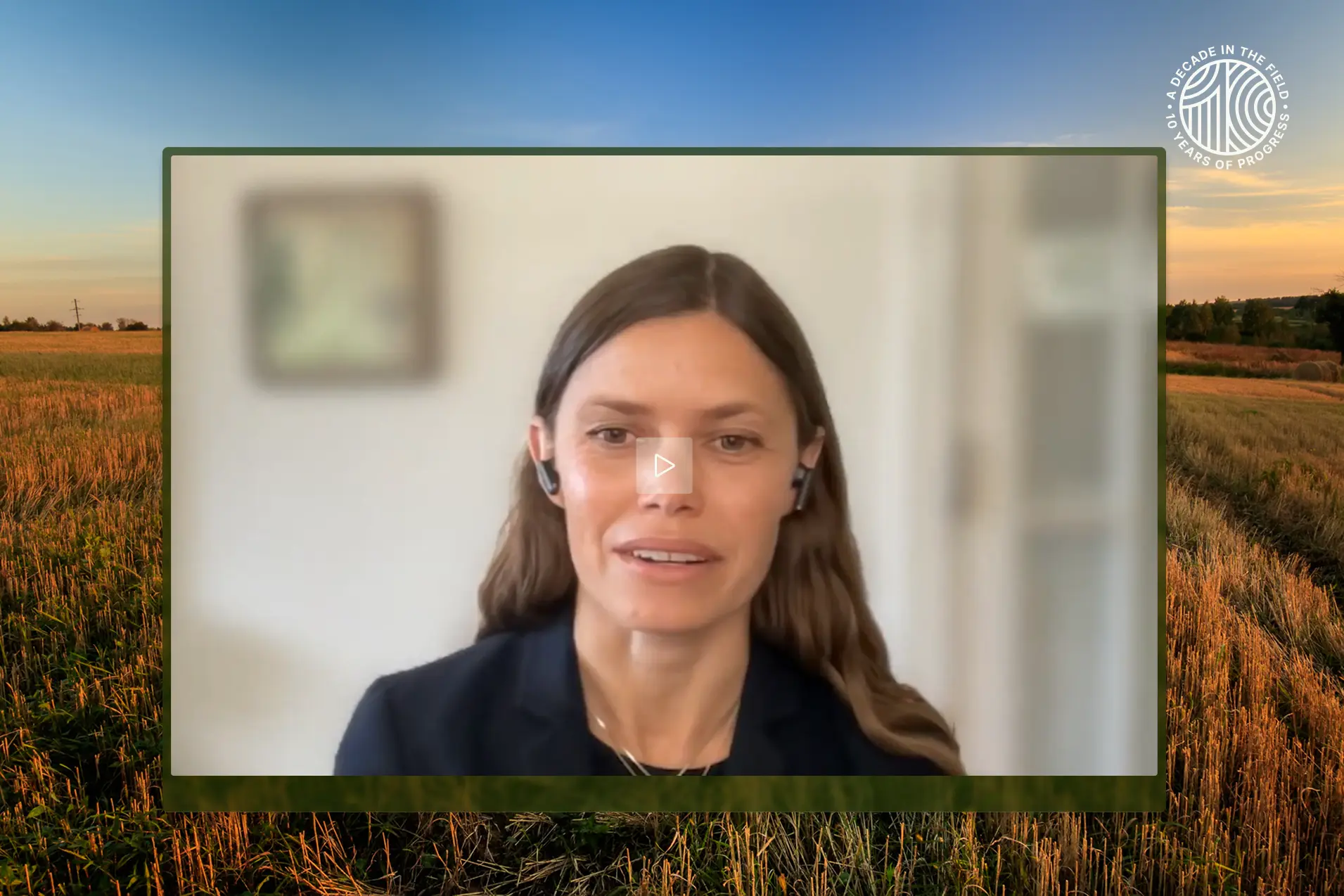
Heidi Peterson, Ph.D., has spent over 15 years working alongside farmers and ranchers on conservation, the last seven as Vice President, Agricultural Research & Conservation at Sand County Foundation. She built her technical background in nutrient management, first as the Minnesota Department of Agriculture’s lead technical expert on agricultural practices for impaired waters, then as Phosphorus Program Director at the International Plant Nutrition Institute, alongside adjunct teaching in the University of Minnesota’s Department of Bioproducts and Biosystems Engineering. Across a wide-ranging conversation about value chain partnerships and regenerative program development, a few convictions kept surfacing:
- Lasting progress starts with farmers in the planning process
- Transparency is essential in program development and outcomes measurement
- Consistent program goals are essential for long-term involvement
"It can't just be the corporations working alone. It can't just be the federal government pushing out initiatives," Peterson said. "Without all the stakeholders involved and at the table, the efforts will not be successful."
In her conversation with Regrow, Heidi explains how she came to these convictions, how regenerative agriculture has changed in recent years and what she’s expecting will come next.
Accelerating demand leads to new expectations
Peterson has watched the tools and expectations around this work shift considerably over her two decades in conservation. “Ten years ago,” she said, conversations about environmental metrics were just beginning to take shape. Today, “the demand is really changing fast, which means we continue to deal with new expectations and uncertainty,” and that pace can produce “unrealistic expectations or demands” from funding partners.
Prioritizing communication and transparency across the value chain
Farmer enablement is the core of conservation
Peterson traces her own commitment to this work back to early conversations with farmers who served on research advisory panels. "I really loved listening to them and making sure that their voice was included in where the funding was directed," she said. That instinct has carried through into how Sand County Foundation designs its on-farm work today.
One of the earliest demonstration projects she helped build after joining the foundation still shapes how she thinks about the work. "We directly engaged the farmers around the planning table from day one to hear what their interests were and what the specific management concerns were," she said. One farmer later took her out to his land and shared, candidly, why the transition to regenerative grazing mattered so deeply to his family.
"When you have those conversations, you have that chance to see insecurities and uncertainties in what they're doing, and the importance of the trust that they have in you to work with them in identifying a long-term solution."
That trust runs both directions. Peterson remembers farmers in that same group volunteering their failures as freely as their successes, "in order to prevent others from making those same mistakes."
As she put it, "unless we have farmers at the table in the beginning," none of the rest of the work holds together. "It's a conversation," she said. "You're not going to tell them, this is what we need to do. You're learning together."
The process of learning together ensures that funders are aligned on program goals, the structure is in place for effective communication and measurement, and the practices work on farmers’ land and for their businesses.
In an industry that is frequently misaligned on timing (business priorities change quicker than practices can be implemented and truly integrated into operations), trust and open communication act as the foundation for long-lasting programs and meaningful outcomes.
Transparency and trust in both data and in relationships
Trust is one of three core ingredients Peterson identified as prerequisites for any successful partnership: "trust, transparency, and communication." Data sharing is where this gets tested most directly.
The fix, in her experience, lies in honest relationships between the organizations measuring outcomes and sharing data. "The partnerships, they have to be symbiotic," she said.
She offered an example from her experience: a CPG company may come to Sand County Foundation because it needs to hit corporate environmental goals, while the foundation is focused on delivering technical and financial assistance to farmers and ranchers. Those goals don't have to be identical, but "the work to achieve those goals must align and improve with the partnership." Transparency about what each side needs keeps alignment intact.
Once aligned, organizations must collaborate to ensure that outcomes are measured and allocated appropriately. From Regrow’s perspective, this is where the rubber meets the road. Partnerships endure when each party has the data it needs to monetize outcomes and continue investing in the program. Clear, streamlined data systems between partners can ease the transition into these programs and can help scale programs from one region or crop to another.
Strong communication lines between funders, organizers, and producers
Whether it's about data or relationships, when transparency breaks down, it's farmers who absorb the cost. Heidi described a familiar pattern: a funder's goals shift mid-project, the technical assistance already promised to farmers has to change course, and "that really starts to break down the trust that the farmers have for Sand County Foundation,” even if the miscommunication originated upstream.
"If Sand County Foundation doesn't feel that we have the trust with our funding partners, then how do we convey the trust to the farmers that this is going to be a long-term project?"
The partnerships she considers most durable are built as an ongoing conversation, not a transaction. "We talk through what the regional goals are that we're trying to achieve, and we put together what the approach is going to be," she said, contrasting that with funders who simply ask, "how can you help us reach this environmental metric that we need for this year?"
Consistency matters more than the metric itself
When asked what the industry still gets wrong, Heidi didn't hesitate: shifting priorities. "Rather than switching environmental priorities each year, we really need to focus on system outcomes," she said. Thinking less about whether this year's target is carbon, greenhouse gas, or water, and more about the ultimate landscape goal, will pave the way for durable programs and long-term investment. When the goalpost moves annually, "it will break down trust," and farmers end up carrying the burden of a shifting scorecard they had no say in setting. A consistent, landscape-level goal, she argued, "helps to remove unnecessary burdens" and gives producers a reason to stay engaged for the long haul.
Growing collaborations show signs of future progress
Despite the challenges associated with transparency and communication in regenerative agriculture, Heidi is optimistic.
"I am given hope by seeing the collaborations that are being built between NGOs, the private corporations, and then also the public agencies," she said. "That's how you scale change across a landscape. You can't do it alone."
The work ahead, as she sees it, is less about inventing new tools than about sustaining the trust, transparency, and consistency that let farmers know that, as she puts it, “this is a change that's going to be supported well into the future.”
–
Interested in hearing more about the last decade in regenerative agriculture? Explore our series, A Decade in the Field→
.webp)