

Subscribe to our newsletter
Financial literacy and operational experience highlight the necessity of funding regen ag
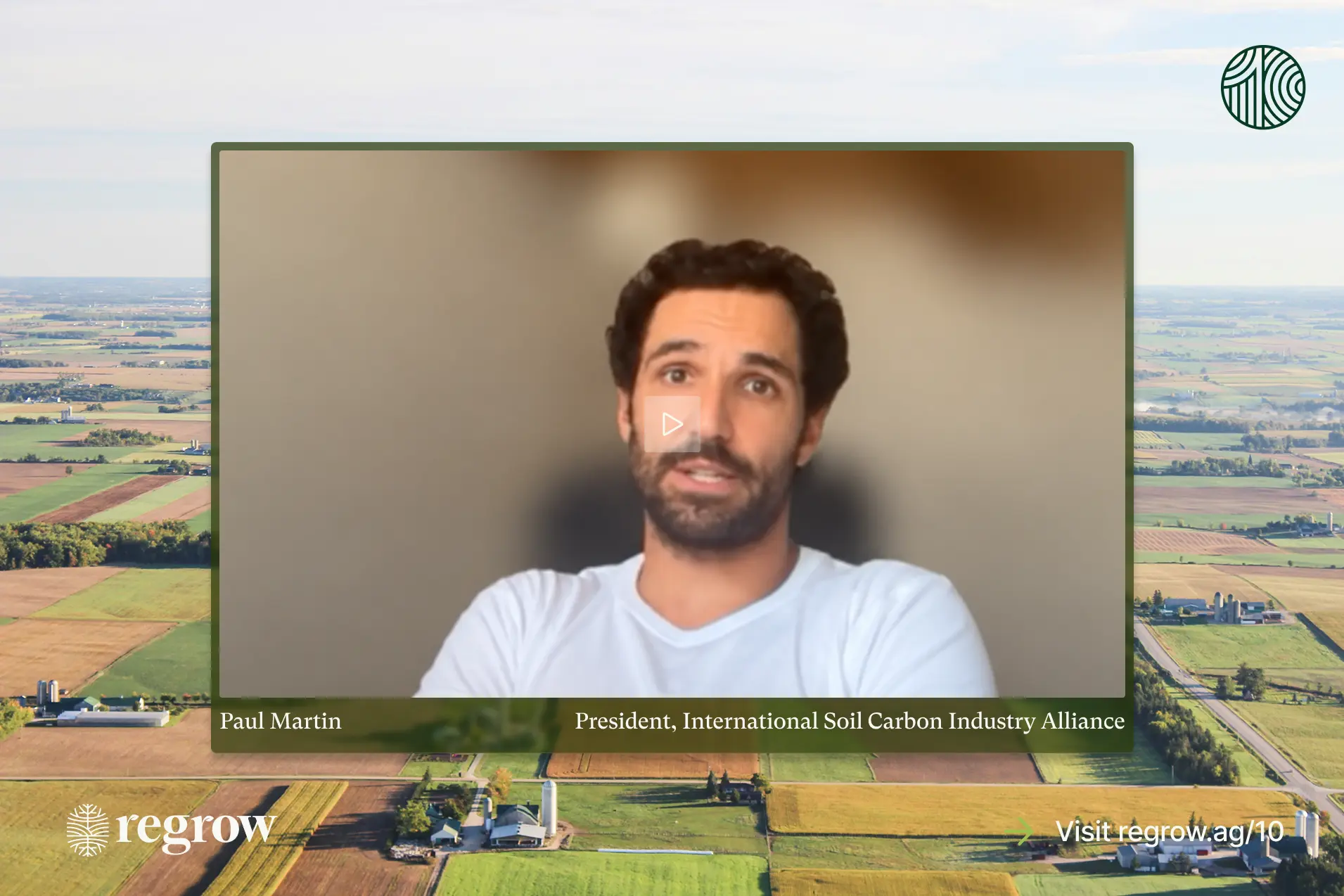
Paul Martin's path into regenerative agriculture started in finance. He spent years managing the agriculture investment vertical of a Middle Eastern sovereign wealth fund before an unplanned turn running the show on the ground. "Because of some management issues, the fund nominated me as Acting CEO of a large food production platform they owned in the Southeast US, composed of two farms in Florida and Georgia," he explains. Running those operations, and eventually selling both farms, gave him something most people in this space don't have: real operational experience in farm management, paired with a finance professional's instinct for how capital actually moves.
"I gained a lot of operational agricultural knowledge and really liked the space," he says, "but I also saw a lot of issues related to intensive agriculture [like] soil erosion, yield decrease, water pollution..." The combination of experience on ground and insight into the balance sheet is the lens Paul has carried into his career in regenerative agriculture.
Today, Paul’s operational experience paired with financial fluency defines his mandate. He is Managing Director of Carbon Programs and Policy at Milpa, a French farming company that transitions French farms to certified organic regenerative agriculture (direct seeding of cereal-legume associations into a permanent C4-type cover crop). Milpa values carbon through Verra’s VM0042 methodology, based on direct measurement of project parcels and a network of control sites. As President of the International Soil Carbon Industry Alliance (ISCIA), Paul leads an alliance that advocates for the development of a robust soil organic carbon and regenerative agriculture market. This market should remunerate farmers fairly for practice changes, and measure outcomes robustly to serve all markets and end uses.
Paul focuses on advancing credible, science-based soil carbon markets that pay farmers fairly. In his opinion, financing soil carbon and regenerative agriculture appropriately has been the biggest challenge in the evolution of the industry over the last 10 years, and it will be a pillar of success in the industry’s future.
Profitability has always been the priority
When asked how regenerative agriculture has changed over the last decade, Paul is candid: we must change our support structure to accelerate regenerative practice adoption. "No matter where [farmers] are from or what age they are, they are all interested in the resilience of their farming system," he says. Farmers are looking for financial stability within their operations. We see this in today’s focus on yield output, as it’s what pays most consistently. Ultimately, profitability determines whether a farmer sticks with a new practice or abandons it.
If we can shift the focus to profitability per hectare or acre, rather than yield alone, farmers will be more likely to adopt regenerative practices and stick with them.
As Paul says, "The situation is very difficult for the majority of farmers, and the only thing they really seek is a farming system that sustains itself and allows them to live decently from it."
For Paul, that's the test every regenerative program has to pass. Programs must work for farmers on their land and in their financial reality.
We need to change what’s profitable for farmers
Getting there requires what he calls finance stacking: layering multiple sources of voluntary capital for now, so no single buyer type has to carry the full cost of transition. These capital sources include inset markets, offset markets, public pre-financing and government subsidies. Right now, that stack is lopsided. "Corporates are far from playing the role they should in financing regenerative agriculture and tapping the carbon sink to rebuild soil health," he says.
The need to finance regenerative agriculture is immediately apparent to organizations in the ag industry or with agriculture-based supply chains. However, companies across the entire economy are financially exposed to depleted agricultural soils, and Paul argues they should be part of the financing structure for resilient farming.
Getting companies across the economy to finance a more resilient agricultural system can already happen through carbon credits and the co-benefits they deliver. Whatever the investment tool (carbon credits, EACs, Scope 3 programs, preferential insurance or loan terms, etc.), the idea is that any company can find a way to invest in regenerative agriculture. The market is still nascent and buyers are still learning about it. Historically, forests were the only nature-based solution available to companies investing in nature. Agriculture is now being added to their nature-based solutions portfolios.. We need to build momentum and commitment within the ag value chain.
"Companies within the value chain are still developing pilot projects with a select group of participants, rather than pursuing systemic involvement."
This gap in finance is the difference between continued soil depletion and resilience at scale. Like most innovations across history, Paul doesn't think voluntary goodwill will close the gap. We’ll need stronger drivers, like policy and regulatory markets that make the investment in nature a financial asset and not anymore a voluntary decision based on communication budget.
Public policy like the EU's CRCF is a start, but "demand is still lacking and remains based on a voluntary framework, which does not work to support the financing of regenerative agriculture at scale." Ultimately, he argues, "the value chain alone will not finance it on a voluntary basis before we have an agricultural ETS or another form of regulatory market.”
In Paul’s words, the future of this transition depends on compliance markets and serious corporate investment alongside voluntary demand.
Robust outcomes measurement unlocks investment
Paul believes that scientifically robust outcomes is the biggest investment accelerant, alongside mandatory regulation. "Scientific robustness is what triggers the appetite to invest for large, sophisticated buyers, and it's the condition for reaching premium valuations for carbon farming units."
Boiled down, "a robust carbon farming program delivers on two key aspects: 1) paying farmers fairly for implementing practice changes, and 2) robustly measuring the outcome of those practices."
The true cost of practice adoption
Paul brings a finance lens to this conversation, so naturally he’s been thinking about the cost of practice adoption. His assessment is a bit of a hot take.
He puts the real cost of funding the transition to regenerative practices at roughly €100 per hectare per year.
"[At The International Soil Carbon Industry Alliance], we often cite the minimum of €100/ha/year for a simple cover crop, since it gives a sense of the financing gap relative to the value currently delivered by projects.”
He knows that figure runs well ahead of what today's market actually pays. He's proposing it as a price target and as a diagnostic: it's the number that shows exactly how far current project economics fall short of what farmers need to make the transition stick.
Closing that gap also means bringing scientific rigor to our program outcomes so we can ensure high value for farmers. Buyer demand won't scale without confidence in the numbers behind it, and Paul frames this as a balancing act rather than a box to check: "It is important to find the right balance between scientific integrity, which translates into costs… like parcel-level data collection, soil sampling, certification/audit costs, etc… and practical implementation — no administrative burden for farmers, non-prohibitive costs for buyers, etc."
The future will be driven by economic necessity
Pull those threads together, and Paul’s vision for the next decade of regenerative agriculture rests on three things:
- Unwavering focus on what actually supports the farmer
- The ability to stack financing so the burden of transition doesn't sit on any one buyer's shoulders
- A clear-eyed sense of the balance between scientific rigor and practicality needed to scale carbon farming projects for real
Ultimately, Paul is hopeful about the next ten years in regenerative agriculture. But his hope is rooted in hard economics rather than optimism for its own sake. "The conventional way of farming is not sustainable from an economic standpoint," he says, pointing to synthetic fertilizer and oil prices as much as to climate change itself.
Farmers are seeing the constraints in the industry, between climate stress and other factors, and will respond accordingly. "Farmers will either exit production or look for alternatives. Many are already emerging in various regions, and the scale-up is underway."
The current system, in other words, is running up against a wall it can't get around. That, more than any campaign or policy win, is what convinces Paul the shift to regenerative agriculture isn't a question of if, but of how fast the financing can catch up.
Read more insights on the last 10 years in regenerative agriculture, as part of our Decade in the Field series →