


Contributors

Subscribe to our newsletter
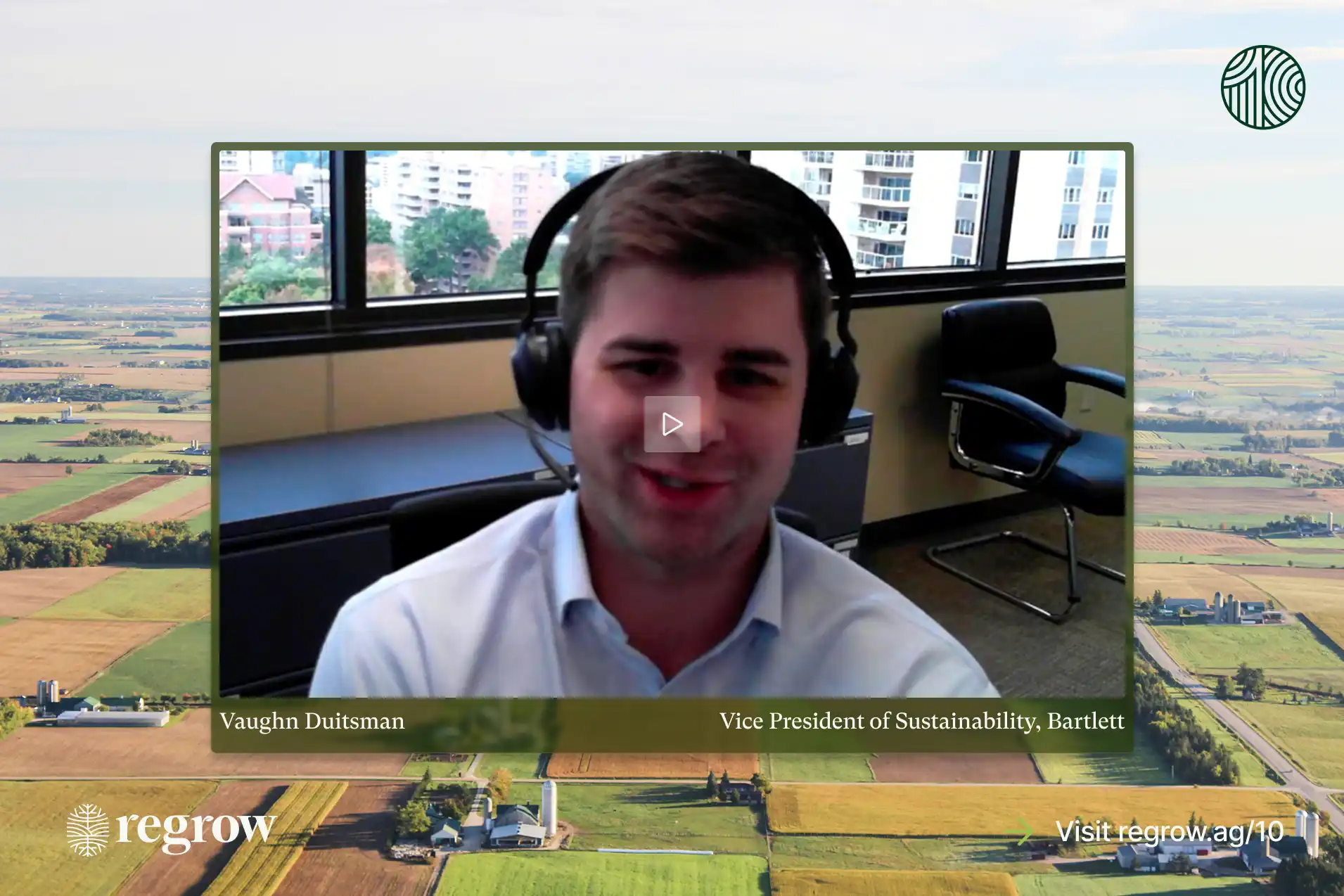
Vaughn Duitsman joined Bartlett thirteen years ago, bringing an agricultural economics background and a family farm upbringing to a company that had just begun asking what sustainability meant for a grain business.
When Bartlett stood up its sustainability function in 2015, Vaughn became its first hire, watching the company's regenerative agriculture work evolve from its very first reporting spreadsheet. Bartlett, founded in 1907, spans grain trading, milling operations and soybean processing, ranking among the largest U.S. grain exporters to Mexico. This scale gives Vaughn a unique perspective on grain supply chains, including the risks they face and their opportunities for resilience.
Vaughn walked through how the purpose of regenerative agriculture programs has changed since 2015, how the balance of interest between growers and downstream customers has shifted (and may have flipped), and what it will take for climate-smart farming to reach real scale.
From reporting exercise to risk management
When Bartlett's sustainability program started in 2015, Vaughn said its purpose was straightforward: meet internal and external reporting goals. That's no longer the primary driver of sustainability programs.
In the years since, the work has shifted toward de-risking the supply chain. Vaughn notes that COVID accelerated this shift considerably, as supply chain transparency and risk management moved from a nice-to-have to a central business concern almost overnight.
That shift has come with a tangible cost. As programs, policies and the science behind outcomes quantification have scaled, CPG partners have pushed for more granularity in what they're paying for, alongside a much sharper downstream focus on fine-tuning the return on these investments.
This scrutiny underscores a business truth. As Vaughn noted,
"If these crops that growers are producing are not delivered to these downstream customers, they can't run their business. So managing [supply chain] risk is very, very important for [downstream customers]."
In other words, Vaughn sees sustainability spending now treated as any other supply-continuity investment, a sign that the work has matured past its early, reporting-only phase and into the realm of business strategy.
A surge in grower interest meets downstreams’ economic headwinds
A decade ago, Vaughn said, downstream interest in regenerative programs was high, and the real question was whether there would be enough participating growers to meet demand. Today, grower interest is increasing as more producers see the agronomic benefits of these practices firsthand. USDA programs (despite recent funding uncertainty) and tax incentives like 45Z are helping to accelerate this interest.
From Vaughn’s perspective, many producers have long been thinking about implementing climate-smart farming practices, but they needed more supply chain support to make the jump. Now, they’re seeing this support through private companies and government-driven programs, and it feels as if the pathways are finally opening for them.
Downstream, meanwhile, the macroeconomic environment has become more challenging. Companies aren't walking away from their programs, but they're more conscious of spend, and growth has slowed compared to five or ten years ago. Vaughn reads this as cyclical rather than a sign of the industry cooling on regenerative agriculture. However, cyclical support doesn’t allow programs the consistent funding or implementation resources needed to make regenerative practices stick.
Risk must be shared across the supply chain, not just with farmers
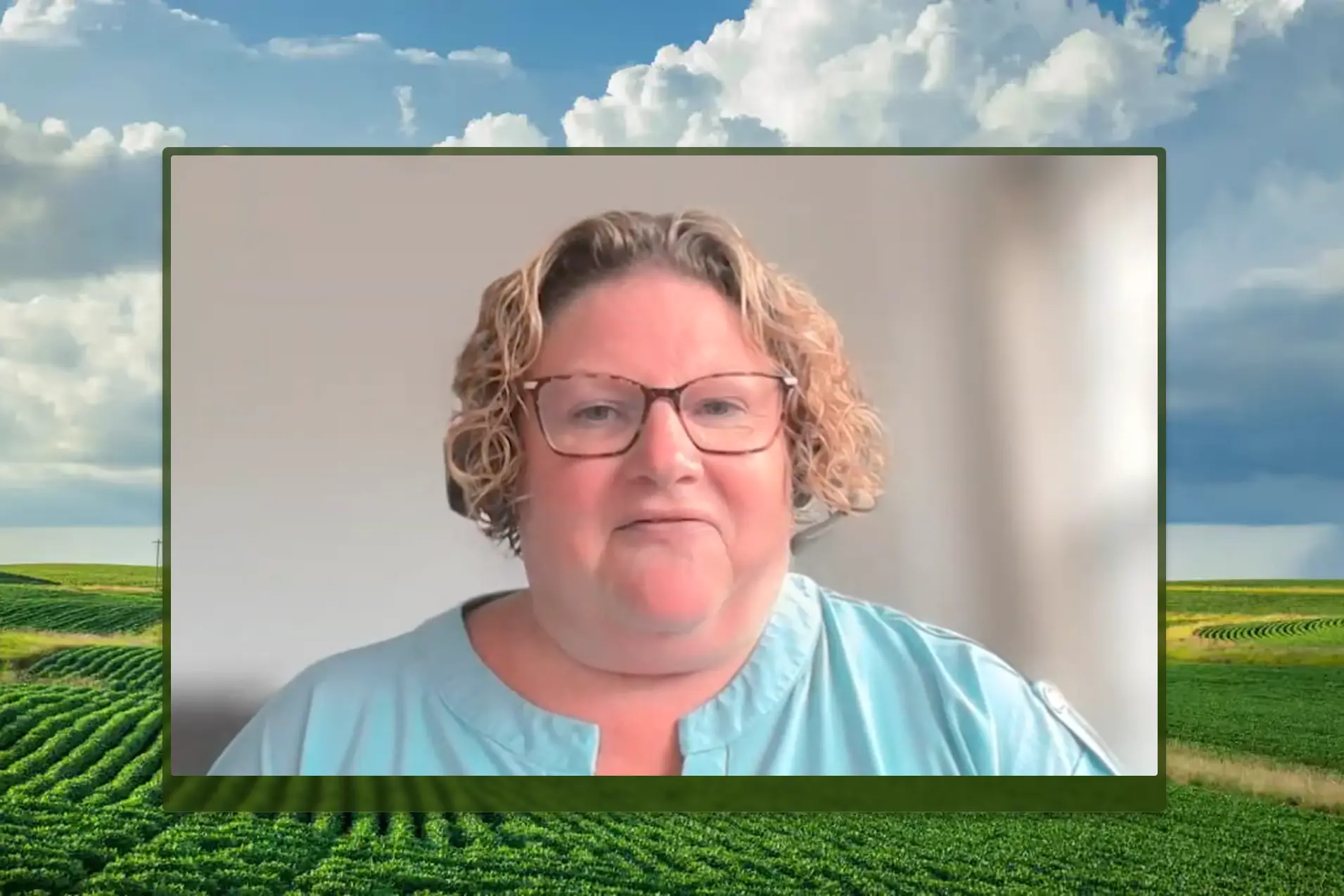
Oatly isn't vertically integrated, which means its regenerative programs depend on a three-way relationship between the company, its mills and its growers. In this structure, the mill serves as the critical link between Oatly and the farmers actually changing their practices. Erin credits much of the company’s progress in regenerative agriculture to growers and suppliers willing to build programs collaboratively rather than simply comply with a set of requirements.
Erin also highlights a key facet of Oatly's approach to regenerative agriculture: the company’s role in supply chain relationships goes beyond a typical sourcing contract. "Our role is not just to source oats. Our role is to work with the growers on practices that will help improve their overall farm resilience," she said.
Underpinning all of Oatly’s work is a shared-risk model, which is core to scale today: Oatly offsets the cost of adopting a new practice so growers can test it without absorbing the full financial uncertainty themselves. This approach mirrors the same logic Erin applies to supply chain resilience more broadly: by approaching programs at the ecosystem level and sharing risk across contributors, we can establish lasting change that’s both environmentally and financially sustainable for all parties.
Scaling is a flywheel
Asked what the next decade requires, Vaughn said, "It sounds cliche now, but we need to scale." In his view, that means landscape-level, multi-stakeholder programs built for resilience.
These programs are easier to describe than to execute, and even with the growth the industry has seen, current programs are still touching only a small fraction of available U.S. and global farmland.
When executed well, landscape level programs can dilute costs and help to cover the long-term and fixed costs required for regenerative practices.
"[Landscape programs] are diluting fixed costs associated with these programs that enable scale... it's a wheel that feeds itself," he said.
If we can dilute the cost of running a program across more acres and more participants, the next level of scale gets easier to reach, which dilutes costs further still. Getting that flywheel turning, rather than any single technology or policy change, is what he sees as the real work of the next ten years.
Structuring grower payments for the long haul
When discussing scale, Vaughn also pointed to an assumption he thinks needs correcting: some CPGs treat grower payments as a setup cost that eventually goes to zero once a practice takes hold. In his experience, that's not realistic.
A grower's supply shed will always have competing programs vying for their acres, and, "with certain practices, there's annual fixed costs for the grower associated with them implementing the practice.”
These costs don't disappear because a practice has been adopted for a few seasons. Payments may shrink over time as agronomic benefits kick in, he said, but they're unlikely to ever reach zero. Building a program around the expectation that they will is setting it up to fail.
No finish line for supply chain risk
Asked what gives him hope for the decade ahead, Vaughn didn't hesitate: how much value has already shown up on both sides of these partnerships. Downstream customers and growers have both gotten more benefit than expected when they started these programs, and the transparency built into supply chains is starting to pay off for everyone in the value chain, not just the funder writing the checks.
Vaughn also points to something simple but telling: these programs remain voluntary in the U.S., and downstream companies are choosing to keep funding them anyway. That, to him, is a real signal of perceived value, not just compliance.
It also points to why this work doesn't have a natural finish line. "There's always risk to manage in a supply chain," Vaughn said. As long as that's true, the need for these programs isn't going away.
Learn more about the past and future of regenerative agriculture in our series, A Decade in the Field →
.webp)
.webp)