

Subscribe to our newsletter
Together, the organizations are supporting the first smallholder regenerative agriculture projects to issue soil carbon credits under Verra’s VM0042 methodology. The project, Regenerative Agriculture in Rice–Wheat–Maize System for Income Generation (VCS Project 2590), enables hundreds of thousands of farmers across Punjab and Haryana to adopt regenerative practices that improve soil health, reduce greenhouse gas emissions, and generate new income through carbon markets.
By combining Grow Indigo’s farmer network and program implementation capabilities with Regrow’s DNDC (Denitrification-Decomposition) model, the partnership demonstrates how rigorous measurement and verification can enable climate finance to reach smallholder agricultural systems at scale.
The Opportunity in Rice Systems
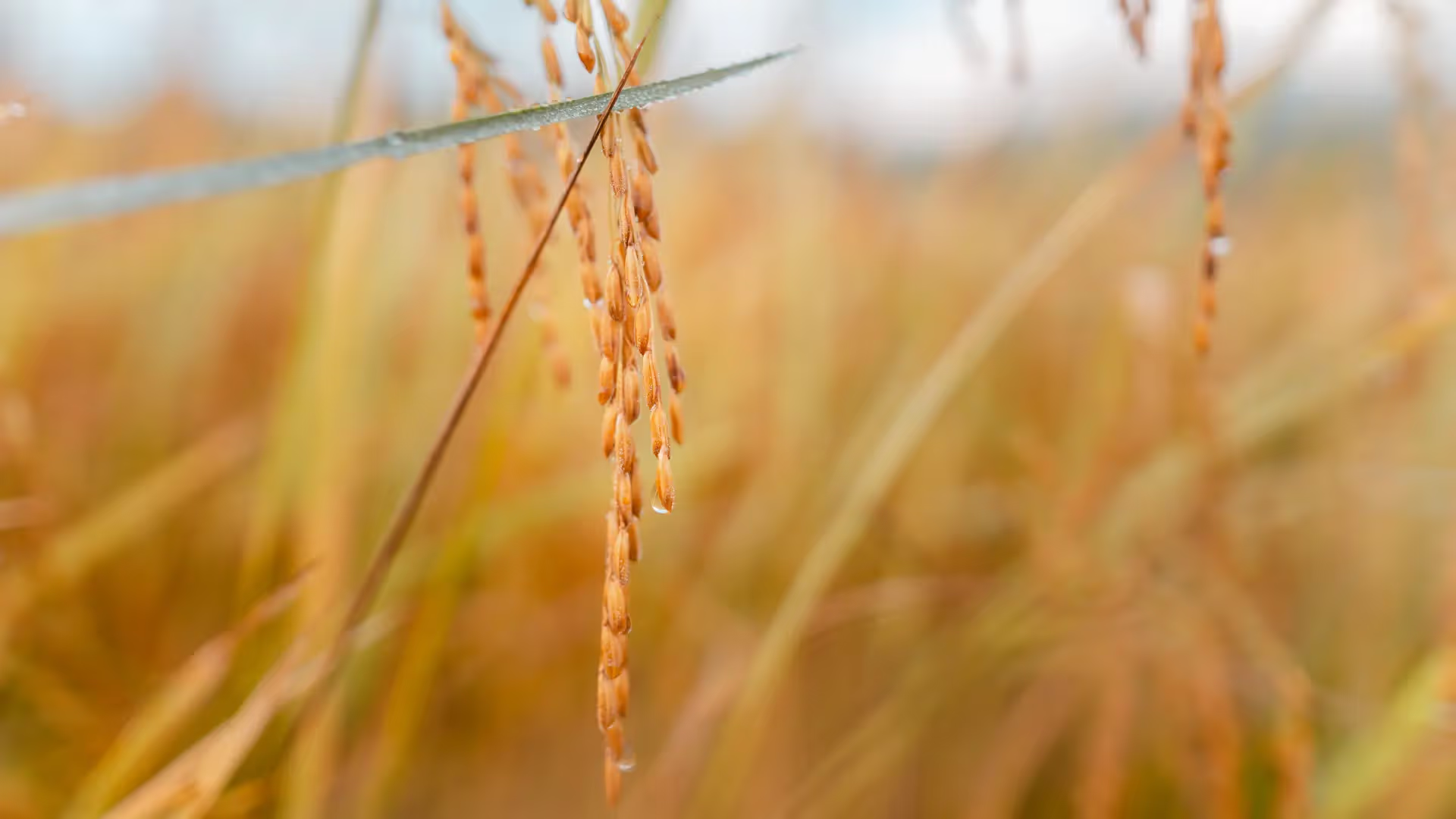
Rice plays an outsized role in global food systems. It is a staple food for more than half the world’s population, with ~3.5 billion people relying on rice as a primary source of calories. At the same time, rice cultivation is one of the largest agricultural sources of global greenhouse gas emissions.
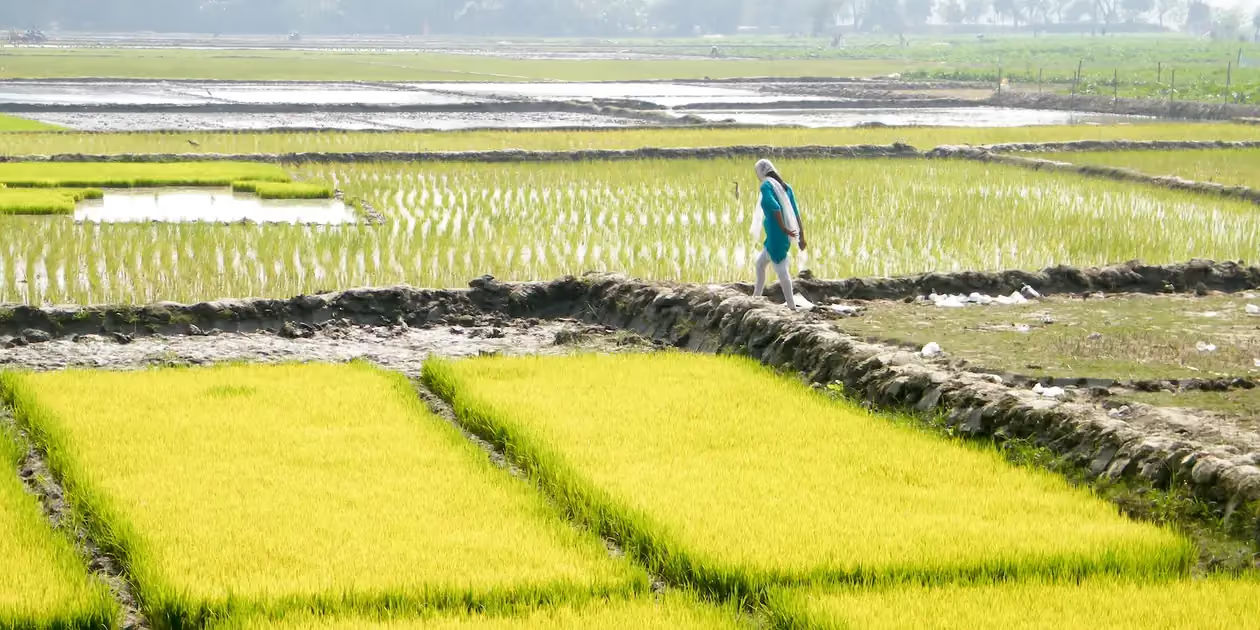
Flooded rice paddies create oxygen-poor soils where microbes break down organic matter and release methane. As a result, rice cultivation is responsible for 10–12% of global methane emissions and about 1.5% of total human-caused GHG emissions.
At the same time, rice systems present a major opportunity for climate mitigation. Practices such as direct seeding of rice (DSR) can substantially reduce methane emissions while improving water efficiency and soil health.
In northern India, where groundwater depletion and soil degradation increasingly threaten long-term productivity, these practices offer important benefits for both climate and farm resilience. Through its regenerative agriculture programs, Grow Indigo is helping farmers adopt these practices while connecting them to new sources of revenue through high-integrity carbon markets.
Measuring Climate Impact in Smallholder Systems
While the climate potential of rice systems is significant, measuring those impacts accurately is particularly challenging in smallholder contexts. Especially, in geographies that employ multi-cropping as agricultural practices can vary significantly across seasons and crops.
Programs in regions such as Punjab and Haryana may involve thousands of small farms, each with different soils, irrigation practices, and fertilizer regimes. Capturing reliable emissions reductions and soil sequestration across these landscapes requires robust monitoring, data collection, and scientifically sound quantification methods.
Rice systems also present a complex greenhouse gas dynamic. Water management practices designed to reduce methane emissions can sometimes increase nitrous oxide emissions depending on soil conditions and nitrogen management. Earlier approaches often struggled to capture this balance, particularly when relying on simplified emission factors. Grow Indigo’s science teams expertly used process-based models such as DNDC to simulate both methane reductions and potential nitrous oxide increases under different management conditions.
New carbon methodologies have responded to this complexity by requiring more rigorous monitoring, modeling, and verification approaches than earlier generation carbon projects.
Grow Indigo’s Aadi Project
Grow Indigo’s Aadi Project (VCS Project 2590), supporting farmers across approximately 140,000 hectares in Punjab and Haryana, represents a milestone in demonstrating that high-integrity regenerative agriculture programs can succeed in smallholder systems.
Importantly, the program is designed around a farmer-first economic model. Approximately 75 percent of carbon credit revenue is shared directly with participating farmers, providing a new income stream linked to improved land management.
Beyond carbon outcomes payments, the program also delivers broader benefits including improved water use efficiency and quality, increased access to training and agronomic support for farmers and health outcomes for farm labour particularly women.
Regrow supports the Grow Indigo program using the DNDC (Denitrification-Decomposition) model, a peer-reviewed biogeochemical model uniquely capable of simulating the soil chemistry of rice, wheat, and maize production. Unlike most other agricultural models, DNDC tracks daily soil conditions, allowing it to capture both the gradual methane dynamics of flooded paddies, the short-lived nitrous oxide fluxes that occur during field transitions and predict the long-term carbon trends by modeling microbial activities. This daily resolution is critical. Missing a nitrous oxide burst introduces modeling error and undermines the net climate benefit calculation entirely.
By integrating farm-level management data and satellite observations with DNDC, Regrow supports the quantification backbone that makes Grow Indigo's credits auditable, defensible, and ultimately issuable at scale.
The project recently achieved a major milestone with the issuance of 57,463 carbon credits under Verra’s VM0042 methodology, making it the first smallholder soil carbon credit issuances under this standard globally.
Looking Ahead
This issuance is a first, and a strong signal of what’s to come.
Regrow's modeling infrastructure is already validated across the rice-growing regions of Southeast Asia where the next generation of high-integrity programs will emerge. New methodology frameworks, including Verra’s VM51 and emerging Article 6 mechanisms that are beginning to approve rice-specific crediting approaches, are rapidly expanding the market for exactly the kind of rigorous, auditable quantification this program demonstrates.
As Grow Indigo scales in India, and as new program developers enter rice markets across Asia, the blueprint established here becomes a template. Credible carbon programs require the science to match the ambition, and that's what Regrow is here to provide.