

Contributors
Subscribe to our newsletter
As carbon removal markets continue to mature, discussions often focus on whether removals are permanent.
This focus is valid. Long-term climate mitigation depends on actually storing carbon for meaningful periods of time, and permanence has rightfully become a central concept in policy, standards, and market design.
However, as implementation of the Carbon Removals and Carbon Farming Regulation (CRCF) evolves, there is an opportunity to frame these conversations in a way that better reflects the science behind different carbon removal pathways.
Rather than describing removals through terms that can imply a hierarchy of value, we might instead distinguish them by how carbon is stored.
Different pathways store carbon differently
Carbon removal is not a single technology or practice. Rather, it includes a diverse range of approaches, each relying on different biological, chemical, or geological processes.
Some pathways store carbon in geological formations or stable mineral compounds, while others store it through living ecosystems by increasing soil organic carbon, restoring peatlands, expanding agroforestry systems, or supporting forest growth. These pathways differ in many ways, especially how risks are managed and how outcomes are monitored over time.
Recognizing those differences doesn't necessitate placing them in a hierarchy, but we do need to understand that each pathway operates through fundamentally different storage mechanisms. We need to support a market that is prepared to manage multiple removal pathways.
One way to reflect these differences would be to classify carbon removals according to their storage mechanism.
Storage mechanisms offer a more scientifically grounded framework
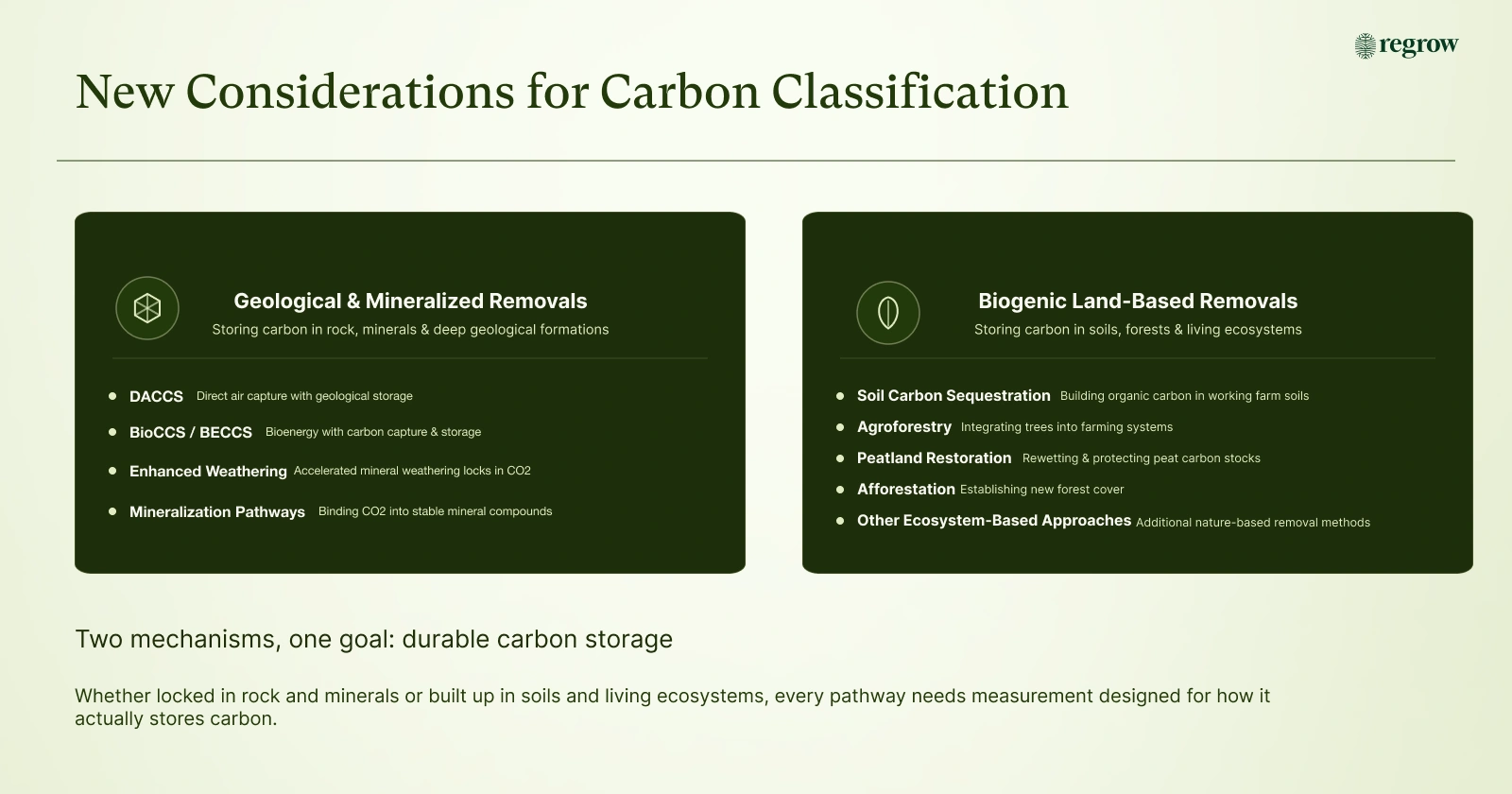
Here's an example of a classification system for storage mechanisms:
- Geological and Mineralized Carbon Removals: including direct air capture with geological storage (DACCS), BioCCS/BECCS, enhanced weathering, and mineralization pathways.
- Biogenic Land-Based Carbon Removals: including soil carbon sequestration, agroforestry, peatland restoration, afforestation, and other ecosystem-based approaches.
This distinction focuses on how carbon is stored rather than suggesting that one category is inherently more valuable than the other. It also more clearly reflects the fact that different storage mechanisms require different approaches to monitoring, stewardship, reversal risk management, and long-term governance.
Different risks require different management
Each carbon removal pathway carries a different risk profile. Land-based removals depend on continued ecosystem management and are influenced by factors such as weather, wildfire, land-use change, and agricultural practices. These systems therefore require ongoing monitoring, transparent accounting, and practical risk management strategies. Geological and mineralized pathways face different technical, engineering, operational, and regulatory considerations.
Neither approach is risk free. Instead, each benefits from governance frameworks that are appropriate for its underlying storage mechanism.
Recognizing these differences allows policy to remain rigorous without forcing fundamentally different systems into the same conceptual framework.
Why focus on land-based removals?
Many ecosystem-based carbon removal activities generate benefits that extend well beyond climate mitigation.
Practices such as cover cropping, improved grazing management, peatland restoration, and agroforestry can simultaneously improve soil health, water retention and quality, biodiversity, agricultural productivity, and resilience to climate shocks. These outcomes complement carbon storage and help build more resilient agricultural systems. For farmers, food companies, and policymakers, these broader environmental outcomes are often part of the reason these practices are being adopted in the first place.
As environmental markets mature, this raises an important question: should land-based removals continue to be valued primarily by comparing their storage duration to geological pathways, or should they also be valued for the broader outcomes they produce?
Tonnes of carbon are essential to climate mitigation. But in agriculture, sequestering that carbon also brings healthier soils, more resilient crops, improved water outcomes, and stronger farming systems.
Those co-benefits are part of the value proposition, and markets should recognize them as such. As measurement systems become more sophisticated, markets have an opportunity to recognize those multiple outcomes rather than benchmarking every removal pathway against a single model of permanence.
CRCF must reflect this diversity in implementation
One of CRCF's greatest strengths is its recognition that carbon removals can come from multiple pathways. As implementation continues, there is an opportunity to ensure that the language used to describe those pathways reflects their scientific differences rather than implying a simple ranking.
Classifying removals by storage mechanism acknowledges that geological, mineralized, and biogenic systems each make distinct contributions to climate mitigation. Each requires robust monitoring and strong governance, but they should not necessarily be expected to deliver identical forms of value.
If Europe wants to build durable carbon markets, the goal shouldn't be to determine which removal pathway is universally "better." It should be to create rigorous frameworks that measure each pathway appropriately, manage its specific risks, and recognize the outcomes it delivers.
This shift creates an opportunity for land-based removals to be valued not only for the carbon they store, but also for the resilience, biodiversity, water quality, and productive agricultural landscapes they help create.
Building durable climate solutions requires accurate understanding, measurement, and governance of every removal pathway. CRCF has an opportunity to establish a framework that recognizes the strengths of each, without forcing different systems into a single hierarchy.
.webp)

.webp)