

Contributors


Subscribe to our newsletter
In April 2026, The Good Rice Alliance (TGRA)—a Bayer incubated initiative—announced a landmark offtake agreement with Amazon covering more than 685,000 metric tons of CO₂e in carbon credits during the initial crediting phase.
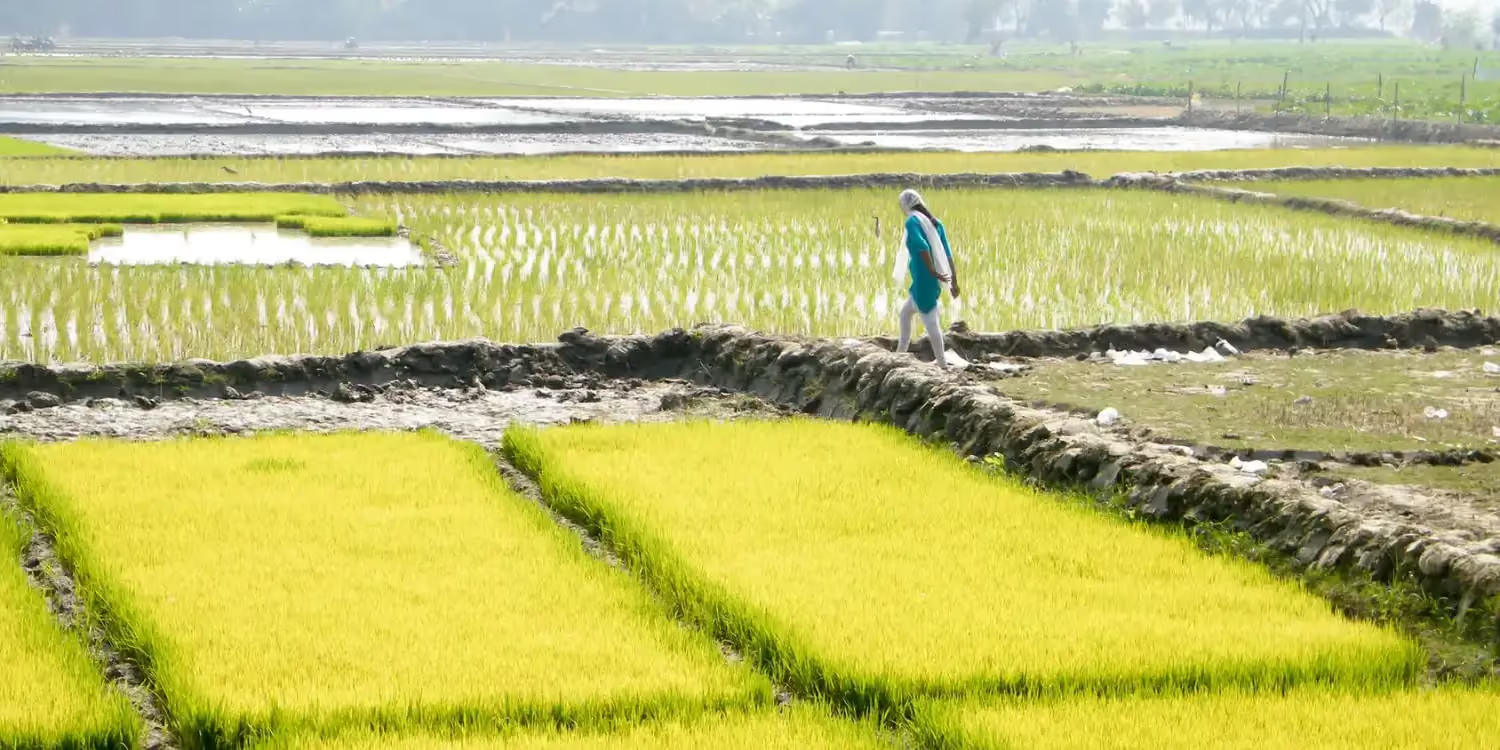
TGRA works with over 13,000 smallholder rice farmers across 35,000 hectares in India, supporting the adoption of Alternate Wetting and Drying (AWD) and Direct Seeded Rice (DSR) to reduce methane emissions. Regrow's DNDC biogeochemical model serves as the quantification engine underpinning TGRA's MRV framework, validated against in-situ field measurements and complemented by independent satellite monitoring under Verra's VM0051 methodology.
We sat down with Regrow's Bill Salas and Bayer's Cornelius Streit to learn more about this program and what it signals for the industry at large.
Q: Cornelius, The Good Rice Alliance has been years in the making. Can you give us a sense of what TGRA is and why Bayer built it?
TGRA was built to prove that you can deliver high-integrity methane mitigation from rice at a scale that actually matters for the climate while creating real value for the farmers at the center of it. India has the largest area of rice cultivation in the world, and conventional flooded paddy systems are the second largest source of agricultural methane globally. That's a massive opportunity.
But the scale of the challenge meant we needed to get the foundations right from the start: the agronomics, the farmer relationships, the on-the-ground infrastructure, and—critically—the science underpinning how we measure and verify emission reductions. The Amazon agreement is a validation that we got those foundations right, with more than 685,000 metric tons of CO₂e over the initial crediting phase, across 13,000 smallholder farmers and 35,000 hectares.
Q: Bill, Regrow's DNDC model is at the core of TGRA's MRV framework. For buyers and partners who may not be deep in the science, why does the choice of quantification method matter so much in rice?
Rice paddies look uniform from the outside, but the methane dynamics underneath are anything but. Flux varies enormously across fields depending on soil type, water management history, temperature, organic matter inputs, and a long list of other factors. The market has historically dealt with that complexity by flattening it, using a single regional emissions factor. This is essentially a coarse blanket estimate, applied across entire geographies.
That approach is simple and scalable, but it can produce credits that don't accurately reflect what's actually happening in the atmosphere. The DNDC (DeNitrification-DeComposition) model was specifically developed to capture those dynamics at field level. What we do is combine direct in-field measurements, conducted here in collaboration with IRRI, with process-based biogeochemical modeling. The measurements calibrate the model; the model then extends that signal across the full project area, accounting for actual field-by-field variation. It's a measurement-plus-modeling approach that aligns to the quality requirements Amazon has defined for rice methane abatement. Seeing that standard applied to an offtake agreement of this size is significant.
Q: Cornelius, TGRA received an ex-ante A rating from BeZero Carbon, the highest for any rice project on their platform. What does that signal, and how does it connect to the quality Amazon is looking for in projects?
The BeZero rating reflects independent scrutiny of the entire program design—our measurement infrastructure, the layered approach to data quality, the scientific rigor behind the quantification. It's meaningful because it's external and it's rigorous. But what I find even more significant is what Amazon's quality requirements signal for the broader market.
When evaluating the integrity of a credit, Amazon is looking for auditable field measurements, independent satellite-based validation of practice change, and biogeochemical modeling. When a buyer of that scale codifies those standards, it raises the bar for everyone. That's how market norms shift. And that shift is ultimately what gets us to a voluntary carbon market that buyers and the public can trust.
Q: Bill, can you walk us through how the different layers of evidence work togethr: the in-field measurements, the satellite validation, and the DNDC modeling?
The layered design is exactly what gives the system its defensibility. Start at the field level: TGRA supports every participating farmer through direct field officer visits, multiple times per growing season, with geo-tagged and timestamped documentation of practice implementation (whether a farmer is applying alternate wetting and drying, or direct seeded rice). That creates an audit trail grounded in direct observation.
Satellite remote sensing acts as an additional layer of verification and confirmation of those field-specific data sets. Over time these models will further improve and get closer to the integrity of ground truth practice data.
The DNDC model sits on top of that foundation. We're using process-based science to quantify methane fluxes across 35,000 hectares, calibrated against in-situ field measurements, validated against independent satellite data. That's a fundamentally different evidence standard than applying a default factor to an area estimate. The result is credits that can withstand scrutiny from verifiers, from buyers, and ultimately from the science community.
Q: Cornelius, what does it mean for smallholder farmers when a program is built this way? Is the rigor compatible with actually reaching farmers at that scale?
The short answer is yes but only if you invest in the on-the-ground infrastructure. TGRA reaches every farmer in the program through in-person field officer engagement, not just digital tools. The scientific rigor and the farmer relationships are not in tension; they reinforce each other. AWD has shown the potential to save farmers up to ~30% on irrigation water, which is a material benefit in water-stressed regions, and a benefit we're measuring with the same rigor we apply to emissions. When farmers see that the program is serious about documenting real outcomes rather than just claiming them, it builds trust and durable practice change.
Q: Bill, Regrow has been applying this measurement-plus-modeling approach in other geographies as well. What does TGRA represent in the context of where this methodology has come from?
Correct; we’ve done similar work in Vietnam’s Mekong Delta through the Transforming Rice Value Chain (TRVC) program. Regrow’s MRV (Monitoring, Reporting, and Verification) platform serves as the technical backbone for the TRVC, a five-year, large-scale initiative (supported by the Australian government and SNV) aimed at shifting the rice sector toward low-carbon practices. The TRVC program is a key component of Vietnam’s national goal to transition one million hectares of rice to high-quality, low-emission production by 2030. The data collected and the quantification of GHG reductions by Regrow’s MRV platform prepares Vietnam’s rice sector for the Voluntary Carbon Market (VCM) and eventual compliance markets
What TGRA represents is the same scientific standard applied at a scale and in a geography where the climate stakes are even larger. India is the world's third largest methane emitter, and rice is a significant part of that. Watching TGRA build a program that doesn't compromise on scientific rigor to achieve scale, and watching a major buyer like Amazon require that rigor as a condition of a 685,000 metric ton commitment, is the market signal that changes what the whole industry has to deliver. We're proud to be the quantification engine behind it.
Q: Finally, what do you each hope this program demonstrates for the future of agricultural carbon markets?
Cornelius: That scale and scientific integrity do not have to be trade-offs. The coordination challenge is real with 13,000 farmers, 35,000 hectares, across multiple Indian states. But we’ve built the infrastructure to meet it without cutting corners on measurement and ongoing farmer support. I hope TGRA becomes a reference point for what high-integrity rice methane mitigation looks like, and that it demonstrates to other buyers, certifiers, and program developers that this standard is achievable. Methane from rice is one of the most immediate levers we have for slowing near-term warming.
Bill: As Cornelius said, rice accounts for roughly nine percent of global methane emissions, with a warming potential more than 25 times that of CO₂ over a 100-year timeframe. Near-term reductions this decade matter more for the climate trajectory than almost anything else in agriculture. What I hope this demonstrates is that the buyer community has real power to pull the market toward integrity, and that when they exercise it, the science and the infrastructure are ready to meet them.
.webp)
.webp)